
Neural Networks Explained: The Technology That Powers Modern Artificial Intelligence
Artificial intelligence has become part of everyday life, even if most people don’t realize it. Every time a streaming platform recommends a movie you’ll probably enjoy, an online store suggests products based on your interests, or your smartphone recognizes your face in seconds, there’s a powerful technology working quietly in the background.
Although the name sounds highly technical, the idea behind neural networks is surprisingly simple. They are computing systems designed to recognize patterns, learn from experience, and improve their performance over time. Instead of following a fixed list of instructions, they discover relationships within enormous amounts of data, making them one of the most important building blocks of modern artificial intelligence.
Today’s most advanced AI systems—including language models, image recognition software, medical diagnostic tools, fraud detection platforms, and autonomous vehicles—depend on neural networks to process information quickly and make intelligent predictions.
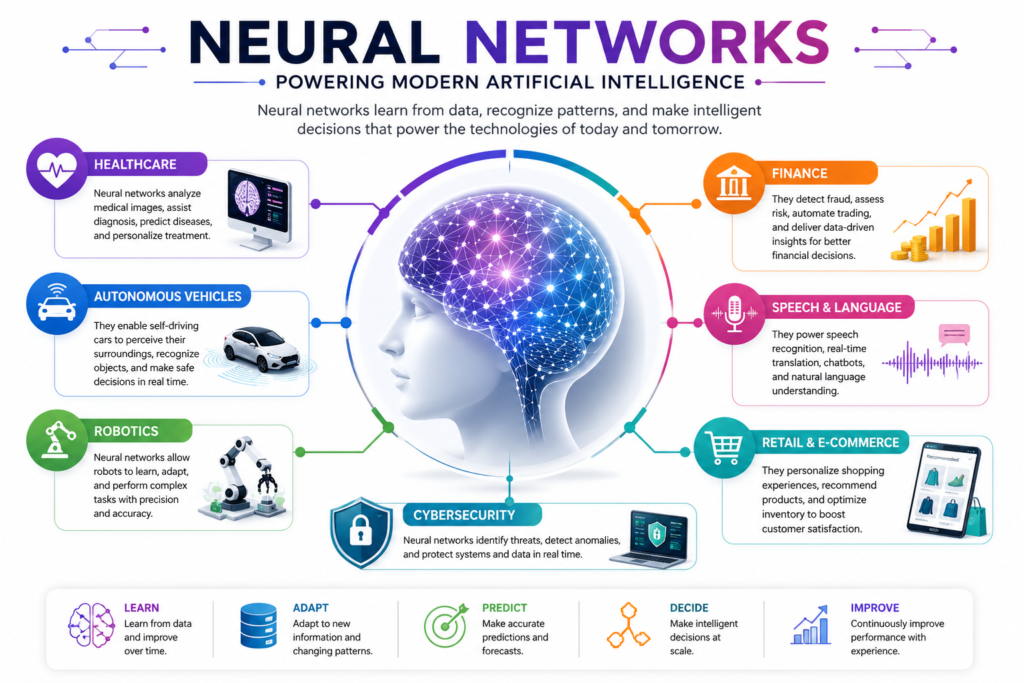
In this guide, you’ll discover what AI models are, how they work, why they have become essential for AI, where they’re used today, and how they may influence the future of intelligent technology.
What Are Neural Networks?
A neural network is an artificial intelligence model designed to learn patterns from data instead of relying entirely on manually programmed rules.
The idea behind intelligent systems comes from the way the human brain processes information. While biological neurons communicate through electrical signals, artificial neural networks use interconnected mathematical units that process information digitally.
These systems don’t actually think like humans. Instead, they identify relationships between pieces of information by analyzing thousands—or sometimes millions—of examples.
For instance, if a neural network is trained using thousands of pictures of dogs and cats, it gradually learns the visual characteristics that separate one animal from the other. After sufficient training, it can correctly classify images it has never seen before.
This learning capability makes artificial intelligence systems far more flexible than traditional software, which depends entirely on predefined instructions.
Why Neural Networks Matter in Artificial Intelligence
Many AI technologies that seem impressive today would not be possible without neural networks.
Unlike conventional computer programs that require explicit rules for every situation, learning models learn directly from data. As they process more information, their predictions usually become more accurate.
This ability allows AI systems to solve problems that involve uncertainty, complex patterns, or enormous datasets—tasks that would be extremely difficult using traditional programming alone.
Neural networks are now responsible for advances in:
- speech recognition
- language translation
- medical diagnosis
- recommendation systems
- autonomous driving
- financial fraud detection
- image recognition
- robotics
Their versatility explains why they have become one of the foundations of modern artificial intelligence.
How Neural Networks Learn
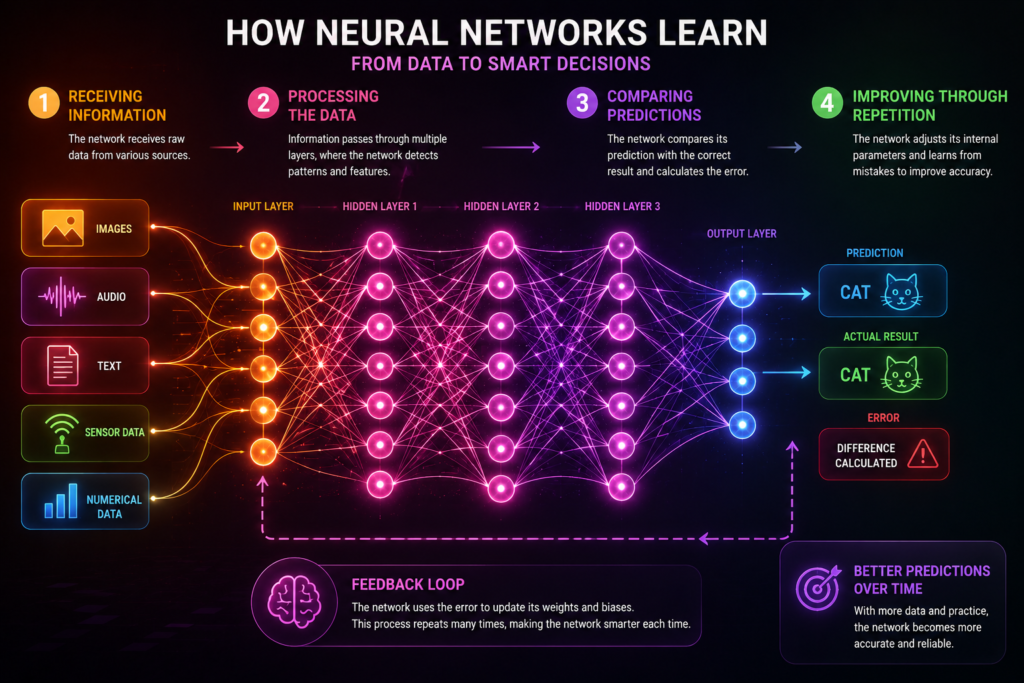
Although the underlying mathematics can become highly complex, the overall learning process follows a straightforward pattern.
1. Receiving Information
Everything begins with data.
This may include:
- images
- videos
- audio recordings
- written text
- sensor information
- numerical business data
The quality of the training data plays a major role in determining how accurately the model performs.
2. Processing the Data
Information moves through multiple connected layers inside the neural network.
Each layer focuses on identifying increasingly complex patterns.
For example, when analyzing an image, early layers may recognize simple edges and colors. Later layers combine those features to identify shapes, objects, faces, or complete scenes.
This gradual processing allows neural networks to understand information step by step rather than attempting to solve the entire problem at once.
To explore how advanced neural networks power image recognition, read our Computer Vision Explained guide.
If you’d like to understand how these learning systems evolved, explore our guide on deep learning.
3. Comparing Predictions
After producing an answer, the network compares its prediction with the correct result.
If the prediction is incorrect, the system calculates the error and adjusts millions of internal parameters to reduce future mistakes.
This continuous correction process enables machine learning models to improve with experience rather than remaining static.
4. Improving Through Repetition
Training rarely happens in a single attempt.
Instead, deep learning systems analyze the same dataset repeatedly, making tiny adjustments after every cycle until prediction accuracy reaches an acceptable level.
This repeated learning process explains why advanced AI models often require enormous computing power and extensive training time before becoming reliable.
The Main Components of a Neural Network
Although architectures vary, most AI models contain three primary layers.
Input Layer
The input layer receives raw information such as images, words, numbers, or sound.
It serves as the starting point where data enters the model.
Hidden Layers
Hidden layers perform the majority of the learning process.
These layers detect patterns, relationships, and meaningful features that help solve the assigned task.
Modern AI systems may contain dozens—or even hundreds—of hidden layers, depending on their complexity.
Output Layer
The final layer produces the prediction.
Depending on the application, this output could be
- identifying an object in an image
- translating a sentence
- predicting financial risk
- recommending a product
- recognizing spoken language
The output becomes increasingly accurate as the network continues learning from larger datasets.
Different Types of Neural Networks
Not every AI problem requires the same network architecture.
Researchers have developed specialized modern AI architecture for different kinds of tasks.
Feedforward Neural Networks
The simplest architecture, where information moves in one direction from input to output without looping backward.
These networks are commonly used for basic classification and prediction problems.
Convolutional Neural Networks (CNNs)
CNNs specialize in visual information.
They power many computer vision applications, including facial recognition, medical imaging, autonomous vehicles, and industrial quality inspection.
Recurrent Neural Networks (RNNs)
These networks process sequential information where previous data influences future predictions.
They have been widely used in language processing, speech recognition, and time-series forecasting.
Transformer Networks: The Breakthrough Behind Modern AI
Artificial intelligence has evolved rapidly over the past few years, and one major reason is the development of transformer networks.
Unlike earlier neural network architectures that processed information step by step, transformers analyze relationships across entire datasets simultaneously. This approach allows AI systems to understand context more effectively while processing information much faster.
Today’s most advanced AI models—including conversational assistants, language translation systems, content generation platforms, and coding assistants—are powered by transformer-based modern AI architecture
Rather than replacing earlier architectures completely, transformers expanded what neural networks could achieve, opening the door to more advanced AI applications across industries.
Where Neural Networks Are Used Today
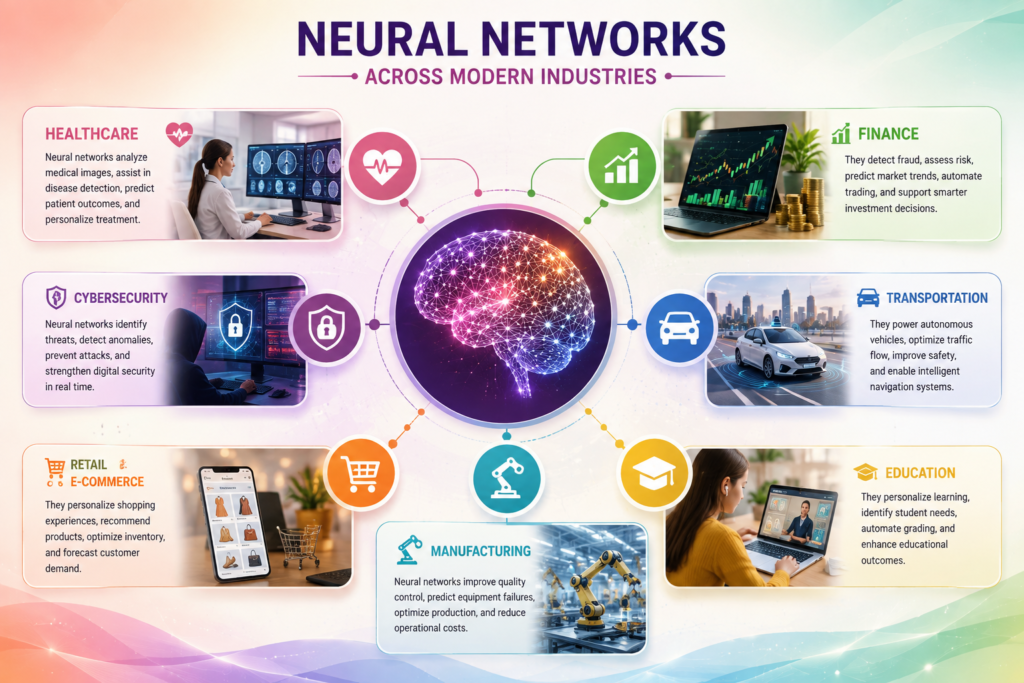
Neural networks now support countless technologies that millions of people use every day, often without realizing it.
Healthcare
Medical professionals increasingly use AI systems powered by these models to analyze medical images, detect patterns, and assist with diagnostic workflows.
These systems help identify abnormalities in X-rays, CT scans, and MRI images while supporting—not replacing—medical expertise.
Financial Services
Banks process enormous volumes of transactions every second.
Neural networks help recognize suspicious financial activity, improve fraud detection, assess lending risk, and support investment analysis using large datasets.
Retail and E-commerce
Online retailers rely on neural networks to personalize customer experiences.
These systems recommend products, predict purchasing behavior, optimize inventory management, and improve customer support through intelligent automation.
Transportation
Modern transportation increasingly depends on intelligent vision and decision-making systems.
Modern AI architecture enables autonomous driving technologies to recognize pedestrians, interpret traffic signs, detect obstacles, and respond to changing road conditions.
Cybersecurity
As cyber threats become more sophisticated, traditional security tools alone are often insufficient.
Neural networks help security platforms identify these AI systems’ behavior, detect malware patterns, and respond more quickly to emerging threats.
Why Businesses Continue Investing in Neural Networks
Organizations generate enormous amounts of digital information every day.
Finding useful insights within that information would be extremely difficult using traditional software alone.
Neural networks help businesses:
- recognize hidden patterns
- automate repetitive tasks
- improve prediction accuracy
- support better business decisions
- personalize customer experiences
- detect anomalies more efficiently
- process large datasets at remarkable speed
For many organizations, these capabilities improve productivity while creating new opportunities for innovation.
Challenges of Neural Networks
Despite their remarkable capabilities, neural networks still present several challenges.
Large Training Requirements
Advanced models often require enormous amounts of high-quality training data before achieving reliable performance.
Computing Costs
Training modern neural networks demands powerful hardware and significant computing resources, making development expensive for many organizations.
Limited Transparency
Some neural networks produce highly accurate predictions without clearly explaining how they reached those conclusions.
This challenge has increased interest in Explainable AI (XAI), which focuses on making AI decisions easier for humans to understand.
Bias in Training Data
If training datasets contain biased or incomplete information, neural networks may unintentionally produce unfair or inaccurate predictions.
Developers continue improving training methods to reduce these risks.
The Future of Neural Networks
Neural networks continue evolving alongside advances in artificial intelligence.
Future developments are expected to include:
- more efficient AI models
- improved medical research
- smarter robotics
- advanced scientific discovery
- intelligent manufacturing
- personalized education
- faster business automation
Researchers are also working to make neural networks more energy-efficient, transparent, and accessible while improving their ability to solve increasingly complex problems.
Final Thoughts
Many of today’s most impressive AI technologies—from intelligent chatbots and recommendation systems to medical imaging and autonomous vehicles—would not exist without neural networks.
Rather than following fixed programming rules, these systems learn directly from data, allowing artificial intelligence to recognize patterns, improve through experience, and solve problems that once required significant human expertise.
As businesses continue investing in intelligent technologies, neural networks are expected to remain one of the most important foundations of modern AI innovation.
If you’re interested in understanding how neural networks support other AI technologies, you may also enjoy reading our guides on machine learning, deep learning, natural language processing, and computer vision.
To learn more about neural networks and their real-world applications, readers can explore IBM’s official guide, which provides practical insights into how modern AI systems learn from data and support intelligent decision-making.
Frequently Asked Questions
What are neural networks?
Neural networks are artificial intelligence models designed to recognize patterns, learn from data, and improve their predictions through repeated training.
Why are neural networks important?
They power many modern AI applications, including image recognition, speech processing, recommendation systems, fraud detection, and autonomous technologies.
Are neural networks the same as deep learning?
No. Neural networks are the underlying technology, while deep learning refers to neural networks with multiple hidden layers capable of solving more complex problems.
Where are neural networks used?
They are widely used in healthcare, finance, retail, transportation, cybersecurity, manufacturing, robotics, and scientific research.
Can neural networks replace humans?
Neural networks can automate specific tasks and improve decision support, but they are designed to assist human expertise rather than replace it entirely.