AI Search vs Google Search: How Online Search Is Changing in 2026
AI search is changing how people discover information online. Instead of simply displaying a list of webpages, newer search experiences can understand questions, summarize information, compare different sources, and provide more direct answers.
For years, Google Search has been the main way people find information on the internet. However, the rise of AI-powered search tools is introducing a different approach. Users can now ask conversational questions and receive responses that are designed to address the intent behind their queries.
This shift does not necessarily mean traditional search is disappearing. Instead, the two approaches are beginning to overlap, creating a new search experience for users and new challenges for website owners.
What Is AI Search?
AI search refers to search systems that use artificial intelligence to understand queries and generate or organize information in a more conversational way.
Traditional search generally matches a user’s query with relevant webpages, while AI-powered systems can analyze information and present a synthesized response.
For example, someone searching for
“What laptop should I buy for video editing under $1,500?”
may traditionally receive links to reviews, shopping pages, and comparison articles.
An AI-powered search experience may instead summarize several relevant options, explain their differences, and help the user narrow down the choices.
This makes the search process feel more like a conversation than a simple keyword lookup.
How Traditional Google Search Works
Google Search has traditionally relied on crawling, indexing, and ranking webpages.
When someone enters a query, Google’s systems attempt to identify pages that are relevant and useful. Ranking systems consider many signals, including content relevance, quality, links, usability, and other factors.
The user then receives a search results page containing links and other search features.
This model has been extremely effective because it gives users access to a huge range of information while allowing them to choose which sources to visit.
However, users often need to open multiple pages before finding a complete answer.
How AI Search Works
AI Search adds another layer to the process.
Instead of only matching keywords with indexed pages, AI systems can use language models to interpret the meaning and context of a question.
A typical AI-powered search process may involve:
- Understanding the user’s query and intent.
- Finding relevant information from available sources.
- Processing and comparing that information.
- Generating a natural-language response.
- Providing supporting links or references where available.
The exact technology differs between search platforms, but the overall goal is similar: reduce the amount of work required from the user.
AI Search vs. Google Search
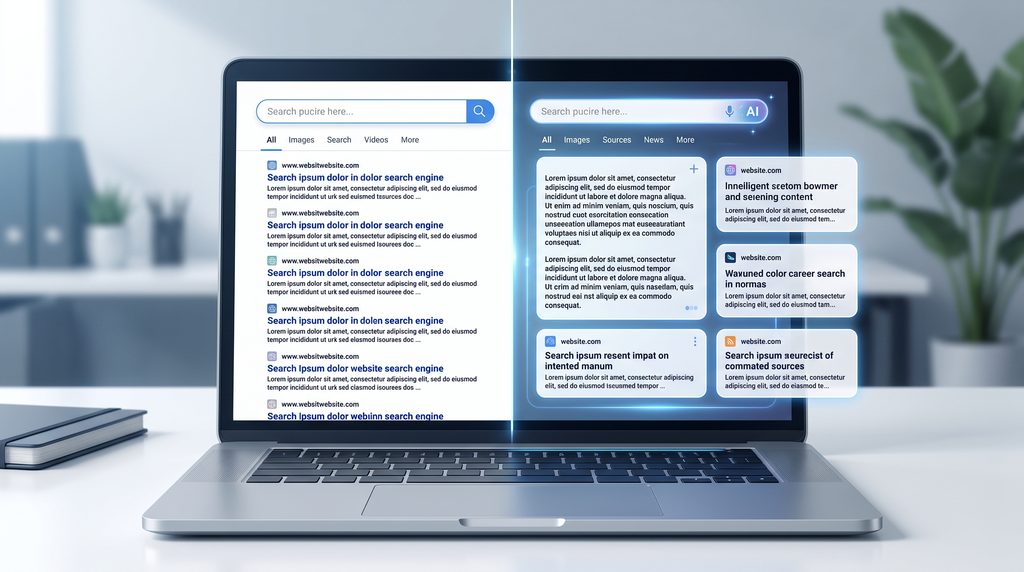
The biggest difference is how information is presented.
Traditional Google Search is primarily link-oriented, while AI Search is increasingly answer-oriented.
Google Search can provide dozens of potential sources, allowing users to investigate information themselves. AI Search may summarize those sources and provide a more direct response.
This creates two different experiences.
Traditional Search
Users typically:
Search → Scan results → Open pages → Compare information → Find an answer
AI Search
Users may experience:
Ask a question → AI interprets intent → Information is summarized → Sources are provided → Follow-up questions are asked
Neither approach is automatically better for every situation.
If someone wants to research a complicated subject, visiting multiple websites may still be valuable. For a quick question, an AI-generated summary may be more convenient.

Why AI Search Is Becoming More Popular
One reason for the growth of AI search is the way people naturally communicate.
Instead of typing short keyword combinations, users can ask complete questions. AI search is closely connected with the broader development of generative AI, which is changing how people interact with digital information.
For example:
Traditional query:
“best smartphone 2026 camera”
Conversational query:
“Which smartphones are worth considering in 2026 if I care most about camera quality?”
AI systems are designed to understand this conversational style.
They can also handle follow-up questions without requiring users to completely restart their search.
For example:
User: Which phone has the best camera?
Follow-up: What about battery life?
Another follow-up: Which one is cheaper?
This conversational flow can make research feel faster and more natural.
AI Search and the Rise of Zero-Click Searches
One of the biggest changes for publishers is the possibility of more zero-click searches.
A zero-click search happens when someone finds enough information directly on the search results page without visiting another website.
Traditional search has already introduced features such as featured snippets and knowledge panels that can answer certain questions directly.
AI-powered search can take this concept further by generating longer summaries.
For publishers, this creates an important question:
If AI provides the answer, will users still visit the original website?
The answer will depend on the type of search.
Someone looking for a quick definition may not need to click.
But someone researching a product, reading an in-depth guide, comparing services, or looking for detailed expertise may still want to visit the source.
What AI Search Means for SEO
AI search is also changing the way website owners think about SEO.
Traditional SEO often focuses heavily on keywords, rankings, backlinks, technical optimization, and search intent.
These factors remain important, but content quality and topical authority are becoming increasingly significant.
Websites should aim to create content that genuinely answers questions rather than simply repeating keywords.
For example, an article about smartphones should not only mention the phrase “best smartphones.”
It should provide useful comparisons, explain specifications, discuss limitations, and help readers make informed decisions.
This creates content that can potentially remain useful across different search experiences.
How Websites Can Prepare for AI Search
Website owners do not need to completely abandon traditional SEO.
Instead, they should build on the fundamentals. For more information about how Google Search works, website owners can refer to the official Google Search documentation.
Create Helpful, Original Content
Content should provide information that is genuinely useful to readers.
Adding original explanations, examples, comparisons, expert perspectives, and practical details can make an article more valuable.
Answer Specific Questions
AI-powered search often deals with conversational queries.
Creating sections that answer specific questions can make content easier to understand and discover.
Use Clear Structure
Well-organized content is easier for both users and search systems to interpret.
Use descriptive headings, short paragraphs, lists, tables where appropriate, and logical sections.
Strengthen Topical Authority
A website covering a subject from multiple useful angles can establish stronger topical relevance.
For a technology website, for example, related articles might cover AI tools, machine learning, cybersecurity, cloud computing, mobile technology, and emerging technologies.
Internal linking can help connect these related topics.
Keep Information Accurate
AI systems can sometimes generate incorrect information.
That makes trustworthy source material increasingly important.
Website owners should verify factual claims, update outdated information, and clearly distinguish between facts, opinions, and predictions.
Will AI Search Replace Google Search?
It is unlikely that traditional search will simply disappear.
Google Search has an enormous ecosystem built around webpages, maps, shopping, images, videos, news, local information, and other types of content.
At the same time, AI-powered features are becoming part of the broader search experience.
This suggests that the future may not be about AI search versus Google search.
Instead, traditional search and generative AI may increasingly work together.
Users may receive direct AI-generated explanations while still having access to webpages and other sources for deeper research.
AI Search Is Also Changing User Expectations
Perhaps the biggest change is not the technology itself but what users now expect from search.
People increasingly want:
- Faster answers
- More conversational interactions
- Better context
- Personalized explanations
- Comparisons between options
- Follow-up questions
- Less time spent opening unrelated pages
This means websites may need to compete not only for rankings but also for visibility within increasingly intelligent search experiences.
What the Future of Search Could Look Like
Search is moving toward a more conversational and interactive model.
Instead of treating every query as a separate event, future systems may understand the broader context of what a user is researching.
Imagine researching a new laptop.
You could begin by asking about processors, continue with battery life, compare two models, ask about pricing, and then request recommendations based on your specific requirements.
The search experience could become a continuous research assistant rather than a collection of disconnected searches.
However, accuracy, transparency, source attribution, privacy, and publisher visibility will remain important issues as these systems develop.
Final Thoughts
AI search is changing the relationship between users, search engines, and websites.
Traditional Google Search remains extremely useful for discovering webpages and exploring information, while AI-powered search introduces a more conversational way to find answers.
For website owners and SEO professionals, the key lesson is simple: creating useful, accurate, well-structured, original content matters more than producing pages designed only around keyword repetition.
Search technology will continue to evolve, but people will still need reliable information.
Websites that focus on genuinely helping readers may be in a stronger position as search becomes more intelligent and interactive.