AI Agents: How Autonomous AI Systems Are Transforming Work and Daily Life
Artificial intelligence is evolving at an extraordinary pace, changing how people work, communicate, shop, learn, and solve everyday problems. From virtual assistants that answer questions instantly to software capable of managing business operations, AI has become an important part of modern life. As these technologies continue to improve, they are becoming more independent and capable of completing increasingly complex tasks.
One of the most exciting developments in this evolution is the rise of intelligent autonomous systems. Unlike traditional software that simply follows predefined commands, AI agents can observe their surroundings, process information, make decisions, and perform tasks with minimal human involvement. This ability allows them to solve problems more efficiently while adapting to changing situations.
Today, these intelligent systems are helping businesses automate workflows… improving customer service, supporting healthcare professionals, strengthening cybersecurity, and increasing productivity across countless industries. As organizations continue investing in intelligent automation, these systems are expected to become even more influential in both professional and personal environments.
In this guide, you’ll learn what AI agents are, how they work, where they are used, their advantages and limitations, and why they are becoming one of the most valuable technologies shaping the future of artificial intelligence.
What Are AI Agents?
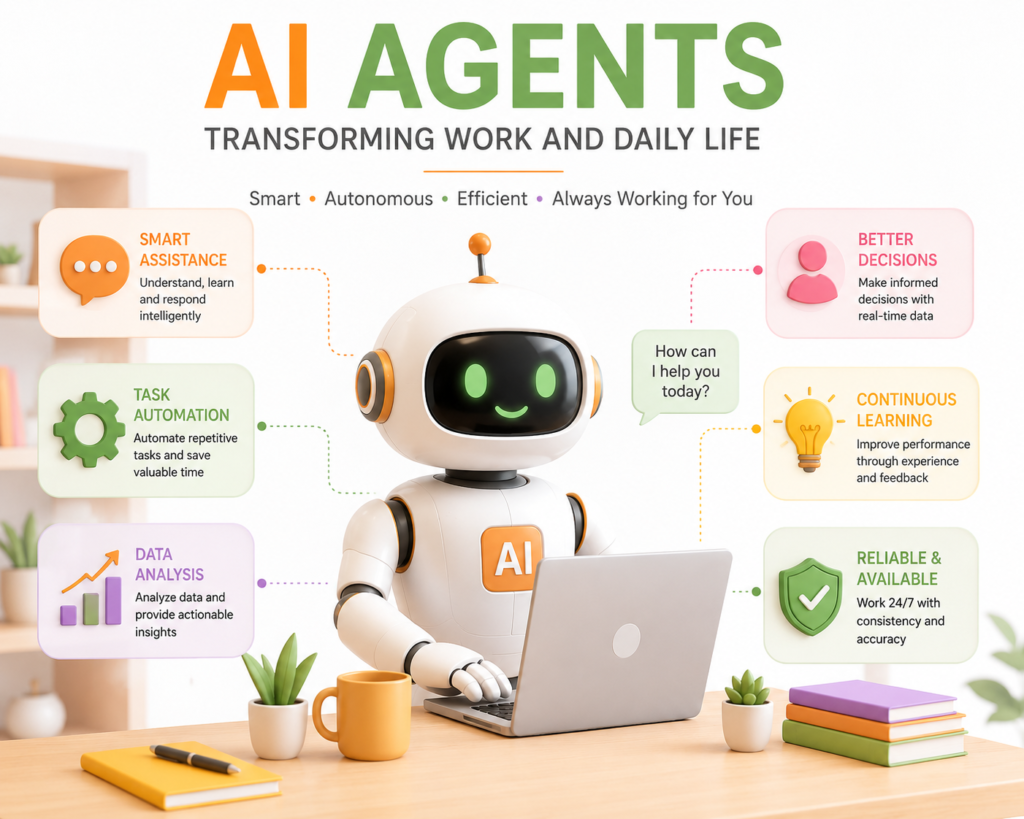
An AI agent is an intelligent software system that can perceive information, analyze situations, make decisions, and perform actions to achieve a specific goal. Rather than waiting for every instruction from a user, these systems are designed to operate with varying levels of independence while responding to changes in their environment.
Unlike conventional software that follows a fixed sequence of programmed rules, AI agents evaluate available information before selecting the most appropriate action. As they process more data and gain additional experience, many agents improve their performance and produce increasingly accurate results.
For example, a customer support AI agent can answer questions, locate relevant information, recommend solutions, and transfer complex issues to a human representative only when necessary. This reduces response times while improving the overall customer experience.
Similarly, AI-powered scheduling assistants can organize meetings, prioritize tasks, send reminders, and adjust calendars automatically without requiring constant supervision.
This ability to combine observation, reasoning, and action makes AI agents one of the most practical applications of modern artificial intelligence.
Why AI Agents Matter
Organizations generate enormous amounts of digital information every day. Processing this information manually has become increasingly difficult as businesses grow and customer expectations continue to rise.
These intelligent systems help solve this challenge by automating repetitive work while making intelligent decisions based on available information. Instead of relying entirely on predefined instructions, they analyze incoming data, determine the best course of action, and continuously improve their performance through ongoing learning.
As a result, businesses can:
- reduce repetitive manual work
- improve operational efficiency
- provide faster customer support
- minimize human error
- analyze large datasets more effectively
- respond quickly to changing conditions
- improve overall productivity
Because of these capabilities, AI agents are becoming valuable tools for organizations of every size.
How Intelligent AI Systems Work
Although different AI agents are designed for different purposes, most follow a similar decision-making process.
1. Gathering Information
Every intelligent system begins by collecting information.
Depending on its purpose, this information may include the following:
- customer requests
- documents
- images
- voice commands
- emails
- sensors
- business databases
- website activity
The more relevant information an agent receives, the better it can understand the situation.
2. Understanding the Situation
After gathering information, the system analyzes the available data to understand what is happening.
Rather than simply looking for matching words, AI agents interpret context and identify patterns that help them make accurate decisions. This enables them to respond more intelligently instead of relying only on fixed rules.
Advanced autonomous systems often combine… natural language processing, machine learning, and reasoning models to better understand complex situations.
Many advanced AI agents also use neural networks to recognize patterns, analyze complex information, and make more accurate decisions in real-world situations.
Types of AI Agents
Not all AI agents are built for the same purpose. Different designs allow them to solve different kinds of problems depending on the environment and the complexity of the task.
Below are the most common types of AI agents.
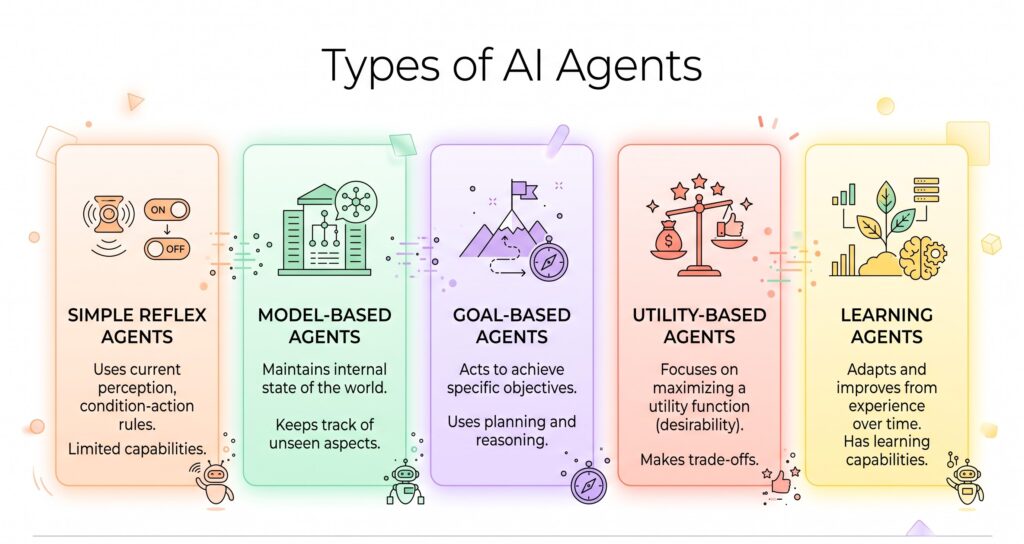
1. Simple Reflex Agents
Simple reflex agents respond directly to specific conditions using predefined rules.
They do not consider previous events or future possibilities. Instead, they react immediately whenever a particular situation occurs.
Imagine walking toward a store entrance—the automatic door detects your movement and opens without requiring any manual action. Similarly, a spam filter can block emails containing suspicious content based on predefined rules.
These agents are fast and efficient but work best in predictable environments.
2. Model-Based Agents
Model-based agents build an internal representation of their surroundings to make better decisions.
Instead of reacting only to current information, they remember previous observations and use them to understand how the environment changes over time.
For instance, a warehouse robot may remember the locations of shelves and obstacles while moving through the building, allowing it to choose safer and more efficient routes.
3. Goal-Based Agents
Goal-based agents focus on achieving specific objectives.
Rather than selecting the first available action, they compare different options before deciding which one is most likely to accomplish the desired goal.
Navigation systems are a common example. They analyze multiple routes before recommending the fastest or most efficient journey based on traffic conditions.
4. Utility-Based Agents
Utility-based agents evaluate several possible outcomes before choosing the one that offers the greatest overall benefit.
Instead of asking only whether a goal can be achieved, they determine which solution provides the highest value while minimizing risk or cost.
Financial investment systems often use this approach by comparing market conditions before suggesting investment strategies.
5. Learning Agents
Learning agents become more effective over time by learning from their experiences and previous interactions.
As they receive more information and feedback, they refine their decision-making process and become increasingly accurate.
Recommendation engines on streaming platforms and online shopping websites use learning agents to provide more personalized suggestions over time.
Real-World Applications of AI Agents
AI agents are already transforming many industries by automating repetitive work and supporting faster, more informed decisions.
Customer Service
Many businesses use AI agents to answer customer questions, resolve common issues, and provide 24/7 support.
Modern chatbots can understand customer requests, locate relevant information, and respond almost instantly, improving response times while reducing operational costs.
Healthcare
Hospitals and healthcare providers are increasingly using intelligent healthcare systems. To assist doctors and medical staff.
These systems help analyze medical records, schedule appointments, identify potential health risks, and support clinical decision-making.
While they do not replace healthcare professionals, they can improve efficiency and reduce administrative workloads.
Finance
Banks and financial institutions rely on AI-powered solutions to detect suspicious transactions, assess financial risks, and automate customer services.
Because these systems analyze enormous amounts of financial data in real time, they can often identify unusual activities much faster than manual monitoring.
Cybersecurity
Cybersecurity teams use intelligent security systems to monitor computer networks, identify threats, and respond to security incidents.
Instead of waiting for human intervention, intelligent security agents continuously analyze network activity and alert administrators when suspicious behavior is detected.
E-Commerce
Online retailers use AI agents to personalize shopping experiences.
These systems recommend products based on browsing history, previous purchases, and customer preferences, helping businesses improve customer satisfaction while increasing sales.
Education
Educational platforms are using AI-powered learning systems to create personalized learning experiences.
Students receive customized study recommendations, practice exercises, and learning materials that match their progress and individual needs.
Benefits of AI Agents
The growing popularity of AI agents comes from the practical advantages they provide across many industries.
Some of the biggest benefits include:
- improved productivity
- faster decision-making
- reduced operational costs
- 24/7 availability
- personalized customer experiences
- greater consistency
- better data analysis
- increased business efficiency
By automating routine tasks, AI agents allow employees to focus on more strategic and creative work.
Challenges and Limitations of AI Agents
Although AI agents offer impressive capabilities, they are not without challenges. Organizations must carefully manage these systems to ensure they operate responsibly, securely, and effectively.
Data Privacy and Security
AI agents often process large amounts of personal and business information. If this data is not properly protected, it can create privacy risks and security vulnerabilities.
Businesses should implement strong cybersecurity measures and comply with data protection regulations when deploying AI-powered systems.
Bias in AI Models
AI agents learn from the data used during training.
If that data contains bias or inaccuracies, the AI agent may produce unfair or incorrect decisions.
Developers must regularly monitor and improve training datasets to reduce these risks.
Limited Human Judgment
Despite their intelligence, AI agents cannot fully replace human reasoning, creativity, or emotional understanding.
Many situations still require human expertise, especially when ethical decisions or complex problem-solving are involved.
High Development Costs
Building advanced AI agents requires the following:
- High-quality datasets
- Powerful computing resources
- Skilled AI engineers
- Continuous maintenance
For smaller organizations, these requirements may represent a significant investment.
Ethical Concerns
As AI becomes more autonomous, questions about accountability, transparency, and responsible decision-making become increasingly important.
Governments and technology companies continue working on ethical guidelines to ensure AI is developed responsibly.
The Future of AI Agents
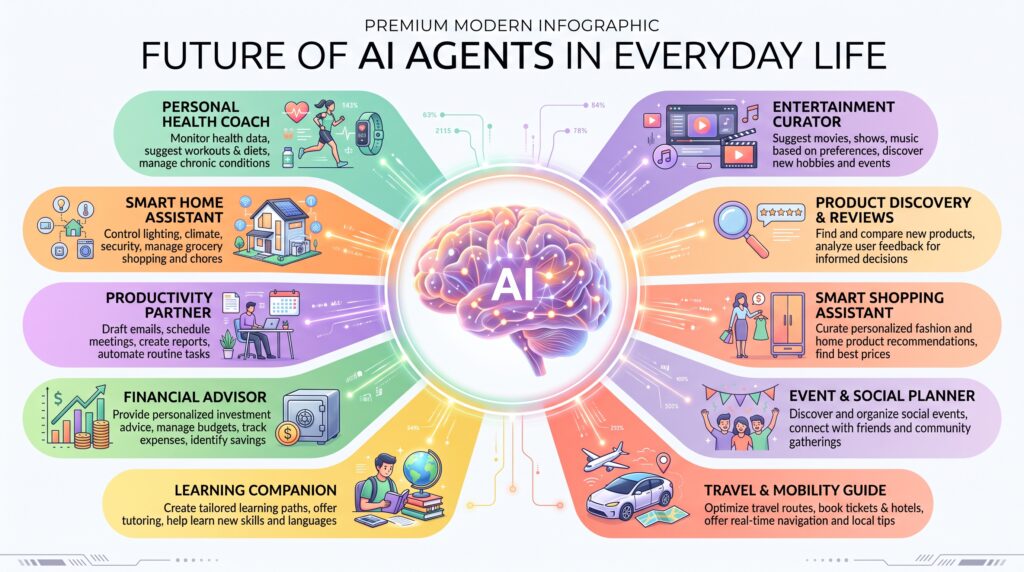
AI agents are expected to become even more capable over the next decade.
Future advancements may include:
- Smarter virtual assistants
- Fully autonomous business automation
- Intelligent healthcare support
- Advanced cybersecurity protection
- AI-powered scientific research
- Personalized education systems
- Smart city management
- Autonomous transportation
Instead of replacing people entirely, AI agents will most likely work alongside humans, helping them complete tasks faster and make better decisions.
As artificial intelligence continues evolving, these intelligent systems will become an even more important part of everyday life.
Frequently Asked Questions
What is an AI agent?
An AI agent is an intelligent software system that can analyze information, make decisions, and perform tasks with minimal human intervention to achieve specific objectives.
Are AI agents the same as chatbots?
No.
While some chatbots function as AI agents, modern AI agents can perform much more advanced tasks, including planning, reasoning, workflow automation, and intelligent decision-making.
Which industries use AI agents?
AI agents are widely used in:
- Healthcare
- Finance
- Cybersecurity
- Retail
- Manufacturing
- Education
- Customer Service
- Transportation
Do AI agents replace human workers?
Generally, no.
AI agents are designed to automate repetitive tasks and assist professionals rather than completely replace them. Human expertise remains essential for creativity, strategic planning, and complex decision-making.
For readers interested in exploring artificial intelligence in greater depth, IBM Artificial Intelligence offers detailed resources covering AI technologies, practical applications, and emerging industry trends.
Conclusion
AI agents are transforming the way people interact with technology by combining intelligent decision-making with automation. Unlike traditional software, these systems can understand information, adapt to changing situations, and continuously improve through experience.
From customer service and healthcare to finance and cybersecurity, AI agents are already helping organizations work more efficiently while delivering better user experiences.
As artificial intelligence continues to advance, AI agents are expected to become even more capable, opening new opportunities for businesses and individuals alike. Understanding how these intelligent systems work today provides valuable insight into the future of autonomous technology.