
Edge Computing Explained: 5 Benefits, Types, and Real-World Uses
Edge computing is becoming an important part of modern technology as connected devices generate more data than ever. Smartphones, security cameras, industrial machines, vehicles, sensors, and other connected devices can continuously collect information that needs to be processed quickly.
Instead of sending every piece of data to a distant centralized data center, edge computing moves some processing and storage closer to where the data is created or where it will be used. This approach can improve response times, reduce unnecessary data transfers, and support applications that need faster decisions.
For businesses, this can be useful in situations where waiting for a remote server to process information is inconvenient or impractical. For consumers, edge technology can quietly support services such as smart devices, connected vehicles, video applications, and other internet-connected systems.
What Is Edge Computing?
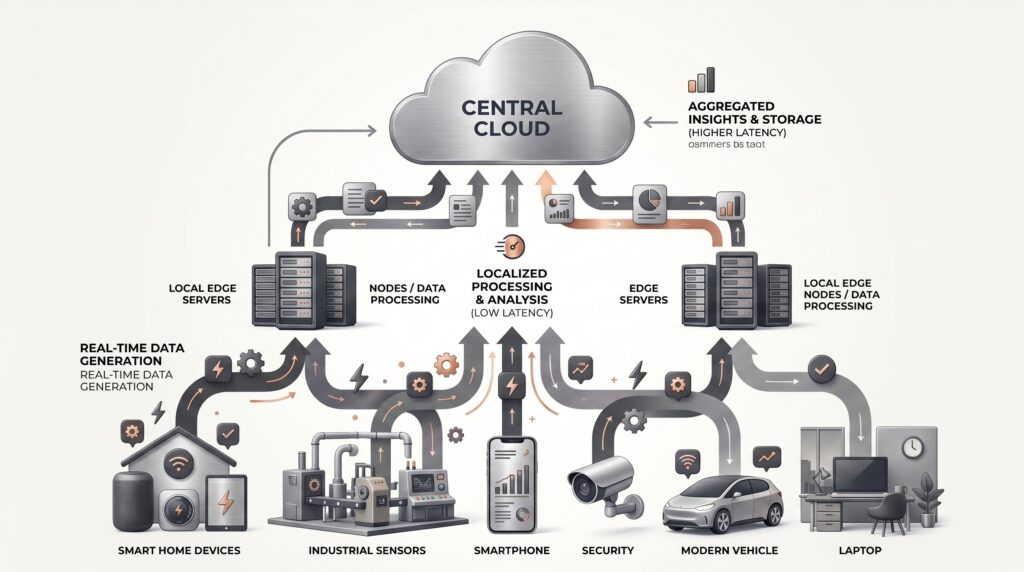
Edge computing is a distributed computing approach that places computing resources closer to data sources, such as connected devices, sensors, local servers, and users.
In a traditional setup, a device might collect information and send it to a centralized cloud or data center for processing. The results are then sent back to the device.
With edge computing, some of that processing can happen closer to the device itself.
For example, a security camera could send video to a nearby edge computer that analyzes the footage instead of continuously sending every frame to a distant cloud server.
The cloud can still play an important role. Edge computing does not necessarily replace cloud computing. Instead, the two can work together, with local systems handling time-sensitive processing while centralized infrastructure manages broader storage, analytics, and applications.
How Does Edge Computing Work?
The basic process can be understood through four steps.
1. Data Collection
Connected devices first collect information.
Examples include:
- Temperature sensors
- Security cameras
- Smartphones
- Industrial machines
- Connected vehicles
- Smart home devices
These devices can generate large amounts of information.
2. Local Data Processing
Instead of sending all raw information directly to a distant data center, an edge device, gateway, or nearby server can process some of it locally.
This may involve filtering information, analyzing data, or running an application.
3. Immediate Response
If the application requires a quick decision, the edge system can respond locally.
For example, an industrial monitoring system could detect an unusual machine reading and trigger an alert without waiting for a complete round trip to a remote cloud environment.
4. Cloud or Central Processing
Important information can still be sent to centralized infrastructure for long-term storage, deeper analysis, reporting, or machine learning workloads.
This creates an architecture where devices, edge infrastructure, and cloud services work together rather than operating as completely separate systems.
Edge Computing vs Cloud Computing
Edge computing and cloud computing are closely related, but they are not the same thing.
Cloud computing generally provides computing, storage, and software resources through centralized or distributed data center infrastructure.
Edge computing moves some of those computing capabilities closer to the devices, users, or locations generating the data.
A simple example is a connected factory.
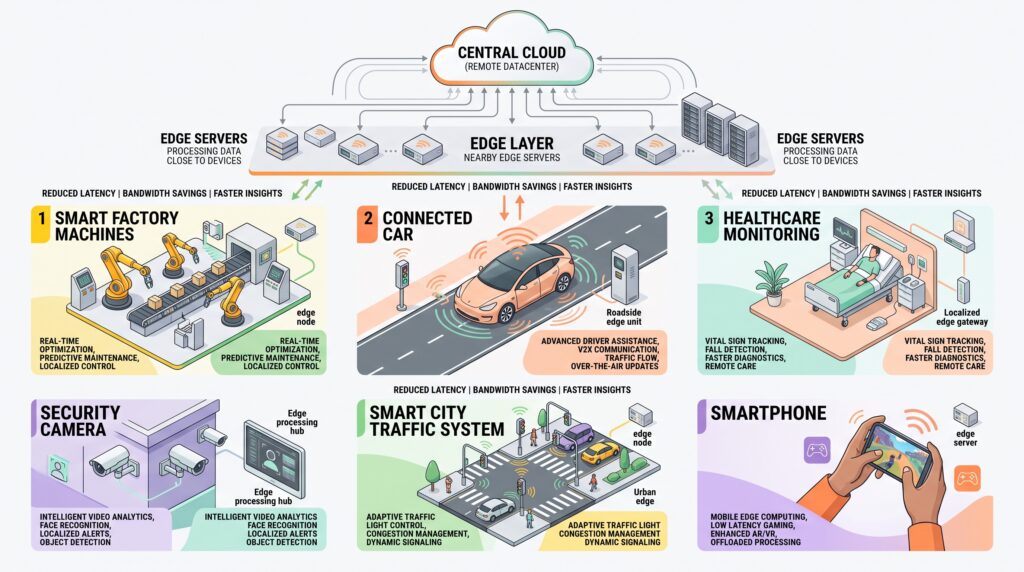
A factory might use edge servers to analyze machine data locally because some decisions need to happen quickly. At the same time, selected data can be sent to cloud infrastructure for historical analysis and centralized management.
This combination can provide both local responsiveness and centralized computing capabilities.
Types of Edge Computing
There is no single edge setup that works for every organization. Edge environments can include different types of devices and infrastructure.
Device Edge
In some cases, processing happens directly on the device that generates the data.
Modern smartphones, cameras, industrial equipment, and other devices can have enough computing capability to perform certain tasks locally.
Edge Gateway
An edge gateway can act as an intermediary between connected devices and larger computing environments.
It can collect data from multiple devices, filter information, manage communication, and forward selected data to the cloud or central systems.
Edge Server
An edge server provides more computing capability than a small endpoint device.
It can be placed in locations such as factories, retail stores, warehouses, offices, or telecommunications facilities.
Edge servers can support applications that need more processing power while remaining relatively close to the data source.
Benefits of Edge Computing
Lower Latency
One of the main advantages is reduced latency.
When data does not need to travel to a distant data center for every decision, applications can potentially respond more quickly.
This can matter for real-time applications such as industrial monitoring, connected vehicles, healthcare systems, and interactive services.
Reduced Bandwidth Usage
Sending every piece of raw data to the cloud can require significant network capacity.
Edge systems can filter or process information locally and send only relevant results or selected data to centralized infrastructure.
This can reduce unnecessary data transfers, particularly in environments with large numbers of connected devices.
Faster Decision-Making
Local processing can help applications make decisions closer to the point where information is generated.
For example, a machine monitoring system could identify an abnormal condition locally and respond before sending detailed information to a central system.
Better Support for Remote Locations
Some environments may have limited or unreliable connectivity.
Edge computing can allow certain applications to continue performing local processing even when communication with a central cloud service is limited.
The exact level of offline capability depends on how the system is designed.
Improved Data Control
Keeping some data closer to its source can give organizations greater control over where information is processed.
However, this does not automatically make an edge environment secure. Edge devices, networks, software, and physical locations still need appropriate security controls.
Real-World Uses of Edge Computing
Edge computing is already relevant to several industries.
Smart Manufacturing
Factories can use sensors and connected machines to monitor equipment and production processes.
Local edge systems can analyze machine information and identify unusual patterns quickly. This may help organizations respond to problems before they cause larger disruptions.
Healthcare
Healthcare environments can generate sensitive information through monitoring devices and connected equipment.
Processing certain information closer to where it is collected can help reduce delays and support applications that require timely responses.
Connected Vehicles
Vehicles can generate large amounts of sensor data.
Some information may need to be processed locally because decisions related to driving and safety cannot always depend on communication with a distant server.
Edge infrastructure can also support traffic management and fleet applications.
Smart Cities
Smart city systems can use sensors to monitor traffic, environmental conditions, public infrastructure, and other services.
Local processing can help systems analyze information closer to where it is generated.
Video Surveillance
Security cameras can produce a continuous stream of video data.
Instead of sending all footage to centralized infrastructure for analysis, edge systems can process selected video information locally and forward relevant events.
Retail
Retail businesses can use edge technology for applications such as store analytics, inventory systems, connected devices, and customer-facing services.
Local processing can be useful when applications need quick responses or when large amounts of data are generated at individual locations.
IBM identifies video surveillance, smart cities, connected cars, manufacturing, telecommunications, financial services, and entertainment among edge computing use cases.
Edge Computing and Artificial Intelligence
Edge computing is also becoming increasingly relevant to AI applications.
Some AI models can be deployed closer to the devices generating data. This can allow certain predictions or classifications to happen locally rather than sending every input to a centralized service.
For example, a camera system could use an AI model to identify a particular event locally and send only the relevant result to a central system.
This approach can be useful when applications require quick responses or need to reduce the amount of data transferred across a network. AWS also describes edge environments where devices can run predictions based on machine learning models and filter or aggregate data locally.
Edge Computing and 5G
5G and edge computing are often discussed together because many applications can benefit from high-capacity networks and computing resources located closer to users.
5G can provide connectivity characteristics that are useful for applications requiring fast communication, while edge infrastructure can provide nearby processing capabilities.
Together, these technologies can support use cases such as connected vehicles, smart infrastructure, industrial systems, and other applications requiring low-latency communication.
It is important to remember that 5G and edge computing are not the same technology. 5G is a mobile networking technology, while edge computing is a computing architecture.
Security Challenges of Edge Computing
Although edge computing can offer useful security and data-control advantages, it also creates new responsibilities.
Unlike a centralized environment with a limited number of protected servers, an edge deployment may involve many devices spread across different physical locations.
Organizations may need to consider:
- Device authentication
- Access controls
- Encryption
- Secure software updates
- Network monitoring
- Physical security
- Logging and auditing
Security should therefore be considered during the design and deployment of an edge environment rather than treated as an afterthought. AWS notes that securing the edge can include protecting devices, edge networks, connections to the cloud, software updates, logging, monitoring, and auditing.
Challenges and Limitations
Edge computing is useful, but it is not automatically the best choice for every workload.
Managing many distributed devices can increase operational complexity. Organizations may also need additional monitoring, maintenance, security controls, and infrastructure.
Edge devices can have limited processing power compared with large cloud data centers.
There can also be challenges involving:
- Hardware management
- Software updates
- Network reliability
- Security
- Data synchronization
- Deployment costs
- Managing many locations
For this reason, organizations generally need to decide which workloads should run locally and which are better handled by centralized cloud infrastructure.
The Future of Edge Computing
As connected devices, AI applications, automation, and real-time services continue to develop, edge computing is likely to remain an important part of modern infrastructure.
The future will not necessarily be about choosing edge computing instead of cloud computing.
Instead, many systems are likely to combine local processing, edge servers, and centralized cloud platforms.
This model can allow applications to process urgent information close to the source while using cloud infrastructure for broader analytics, storage, management, and large-scale computing.
The growing relationship between edge computing, IoT, AI, and 5G makes the technology particularly relevant to industries that depend on fast data processing.
Frequently Asked Questions
Is edge computing the same as cloud computing?
No. Cloud computing generally provides resources through centralized or distributed cloud infrastructure, while edge computing places some processing closer to users and data sources.
Is edge computing only used for IoT?
No. IoT is an important use case, but edge computing can also support healthcare, manufacturing, transportation, retail, telecommunications, video processing, and other applications.
Does edge computing replace the cloud?
Not necessarily. Edge and cloud infrastructure can work together. Edge systems can handle time-sensitive local processing, while cloud platforms can provide centralized storage, analytics, and management.
Is edge computing more secure?
Not automatically. Local processing can provide greater control over some data, but distributed edge environments also introduce additional devices and locations that need to be secured.
Why is edge computing important?
Edge computing can help applications reduce latency, limit unnecessary data transfers, and process information closer to where it is generated.
Conclusion
Edge computing brings computing resources closer to the people and devices that generate or use data. By processing some information locally, organizations can potentially improve response times, reduce unnecessary bandwidth usage, and support applications that require faster decisions.
Its relationship with cloud computing, IoT, AI, and 5G makes it an important technology to understand as digital systems become more connected.
However, edge computing is not a universal replacement for traditional or cloud infrastructure. The right architecture depends on factors such as workload requirements, connectivity, security, cost, and the amount of processing needed.
For businesses and technology users, understanding how edge and cloud environments can work together provides a useful foundation for understanding the next generation of connected applications.