
Machine Learning Explained: How It Works, 7 Benefits, Applications, and Future Trends
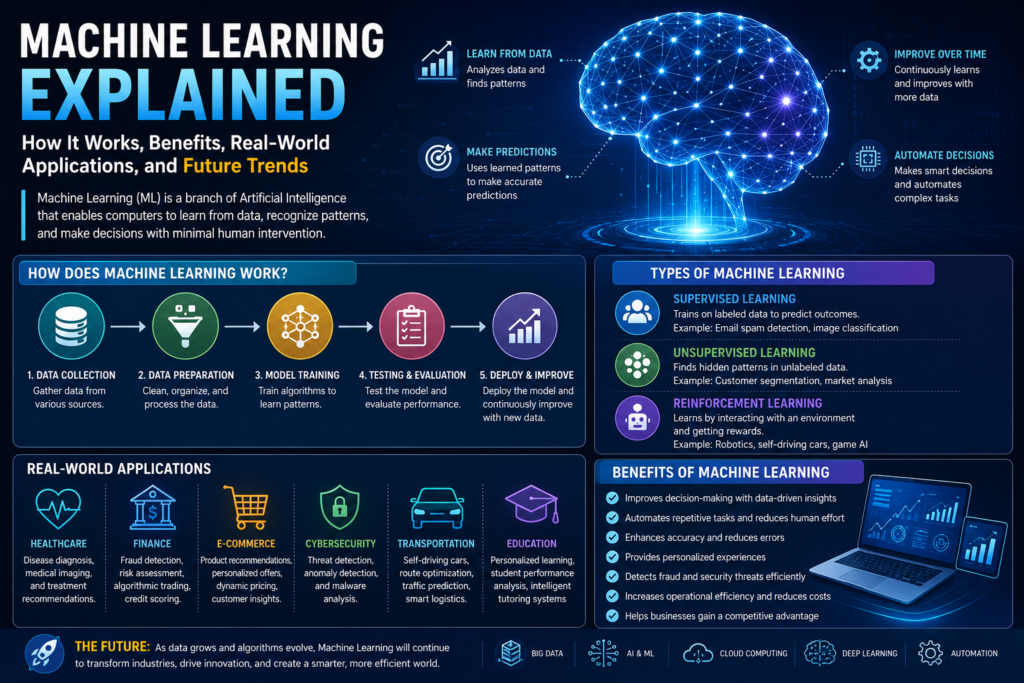
Artificial Intelligence (AI) has become a driving force behind modern innovation, transforming everyday life, businesses, and digital experiences. Behind many of today’s intelligent systems is **(ML)**, a powerful branch of AI that enables computers to learn from data instead of relying solely on pre-programmed instructions. From personalized recommendations on streaming platforms to fraud detection in banking, machine learning has become a key driver of innovation across industries.
In this guide, we’ll explore what machine learning is, how it works, its major benefits, real-world applications, challenges, and why it is shaping the future of technology.
What Is Machine Learning?
Machine learning is a subset of Artificial Intelligence that allows computers to analyze data, identify patterns, and improve their performance over time without being explicitly programmed for every scenario.
Instead of following rigid instructions, learning algorithms study historical data to identify patterns and make predictions or decisions. As more data becomes available, these models can improve their performance over time.
For example, when you search for products online, the recommendations you receive are often powered by machine learning algorithms that analyze your browsing history and preferences.
How Does Machine Learning Work?
Machine learning follows a structured process:
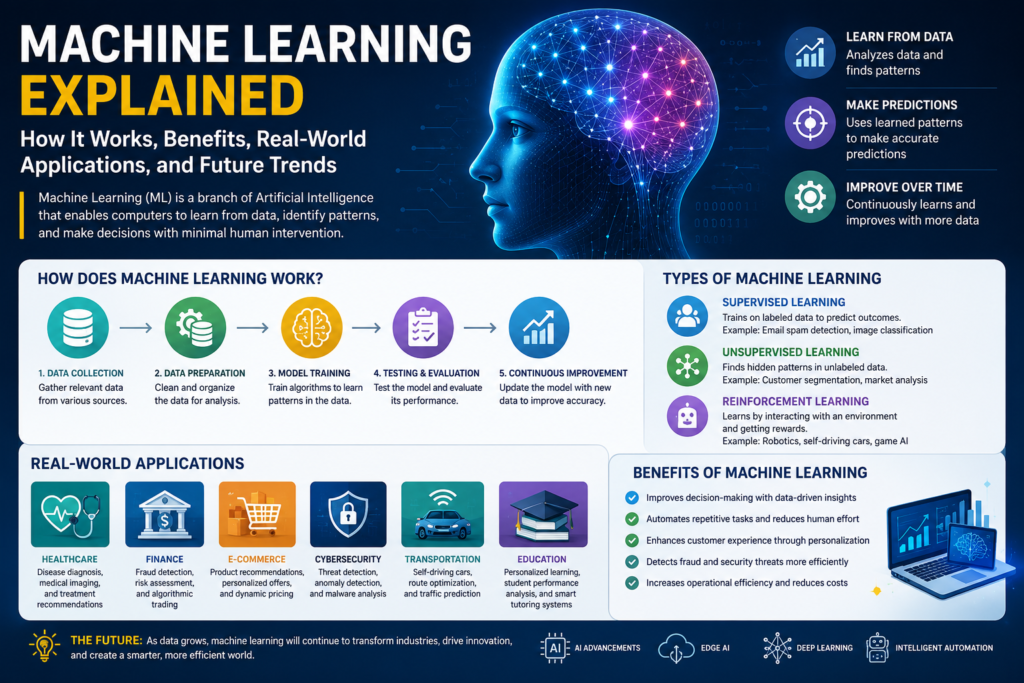
1. Data Collection
The system gathers relevant information from databases, websites, applications, sensors, or user interactions.
2. Data Preparation
The collected data is cleaned and organized by removing errors, duplicates, and incomplete records.
3. Model Training
AI systems’ algorithms study the prepared data and learn relationships between different variables.
4. Testing and Evaluation
The trained model is tested using new data to measure its accuracy and identify areas for improvement.
5. Continuous Improvement
As new information becomes available, the model is updated to improve its predictions and overall performance.
Types of Machine Learning
Supervised Learning
This method uses labeled data to train algorithms. It is commonly used for email spam detection, sales forecasting, and image classification.
Unsupervised Learning
In this approach, algorithms discover hidden patterns in unlabeled data. Businesses often use it for customer segmentation and market analysis.
Reinforcement Learning
The system learns by interacting with an environment and receiving rewards for correct decisions. This technique is widely used in robotics, autonomous vehicles, and game-playing AI.
Benefits of Machine Learning
ML provides numerous advantages for businesses and individuals alike.
* Improves decision-making using data-driven insights.
* Automates repetitive tasks and reduces manual effort.
* Enhances customer experiences through personalized recommendations.
* Detects fraud and cybersecurity threats more efficiently.
* Increases operational efficiency while reducing costs.
These advantages have made Intelligent models one of the most rapidly evolving technologies, driving innovation across industries worldwide.
Real-World Applications of Machine Learning
### Healthcare
Intelligent models helps doctors diagnose diseases, analyze medical images, predict health risks, and recommend treatment plans with greater accuracy.
### Finance
Banks and financial institutions use machine learning to detect fraudulent transactions, assess credit risks, and automate investment strategies.
### E-commerce
Online shopping platforms analyze customer behavior to recommend products, optimize pricing, and improve customer satisfaction.
### Cybersecurity
AI-powered technology systems identify unusual network activity, detect malware, and respond to cyber threats before they cause significant damage.
### Transportation
Self-driving vehicles use Learning algorithms to recognize road signs, detect obstacles, and make real-time driving decisions.
### Education
Educational platforms personalize learning experiences by recommending study materials based on student performance.
## Challenges of Machine Learning
Although machine learning offers impressive capabilities, it also comes with several challenges.
The effectiveness of an AI technology model largely depends on the quality of the data it is trained on. Inaccurate, incomplete, or biased data can result in unreliable predictions and poor decision-making.. Privacy concerns, ethical considerations, and data security remain important issues as organizations collect large amounts of user information. Additionally, developing advanced machine learning models often requires skilled professionals and powerful computing resources.
## The Future of Machine Learning
As technology continues to advance, predictive models is progressing at an unprecedented pace, unlocking new possibilities for businesses and individuals alike. Emerging technologies such as Generative AI, Natural Language Processing (NLP), Computer Vision, and Edge AI are expanding the possibilities of intelligent systems.
In the coming years, Intelligent software is expected to play an even greater role in healthcare, finance, manufacturing, education, agriculture, and smart cities. Businesses that embrace AI-powered solutions will likely gain a competitive advantage by improving efficiency and delivering better customer experiences.
Conclusion
This technology is no longer a futuristic concept—it is already transforming industries and everyday life. By enabling computers to learn from data and continuously improve, intelligent software is making technology smarter, faster, and more efficient.
Whether you’re a student, business owner, or technology enthusiast, understanding Predictive models is becoming increasingly valuable in today’s digital world. As AI continues to advance, these systems will remain at the heart of innovation, powering the next generation of intelligent applications and shaping the future of technology.