
Computer Vision Explained: How AI Enables Machines to See and Interpret Images
There was a time when reviewing thousands of surveillance videos, inspecting every manufactured product, or analyzing hundreds of medical scans required teams of trained professionals working for hours. Today, much of that work happens in seconds—not because cameras have become smarter, but because software has learned to interpret what those cameras capture.
This shift represents one of the most remarkable developments in artificial intelligence. Instead of simply recording images, modern systems can recognize faces, identify damaged products, detect diseases in medical scans, and even understand traffic conditions in real time. Behind these capabilities is computer vision, a field of AI focused on helping machines interpret visual information with increasing accuracy.
Visual data has become one of the fastest-growing forms of digital information. Every smartphone photo, security camera recording, satellite image, medical scan, and online video contributes to an enormous stream of information that would be impossible for humans to analyze manually. Businesses are now turning to computer vision not only to automate repetitive tasks but also to discover patterns and insights that might otherwise remain unnoticed.
As artificial intelligence continues to evolve, computer vision is becoming an essential technology across industries ranging from healthcare and manufacturing to agriculture, transportation, retail, and public safety. Rather than replacing human expertise, it enhances decision-making by processing visual information faster and more consistently than traditional methods.
Why Teaching Machines to See Isn’t as Simple as It Sounds
Humans recognize familiar objects almost instantly.
A quick glance is enough to distinguish a bicycle from a motorcycle, identify a family member in a crowded room, or notice that a traffic light has changed from red to green.
Computers don’t naturally possess this ability.
To a machine, an image is nothing more than millions of tiny pixels arranged in different colors and brightness levels. Without additional processing, those pixels carry no meaning.
For example, a photograph of a cat isn’t immediately recognized as a cat by a computer. Instead, the system must first learn how specific visual patterns—such as ears, eyes, fur textures, and body shapes—combine to represent that object.
Teaching computers to recognize these relationships has required decades of research in machine learning, deep learning, and image analysis.
The result is computer vision, a technology capable of transforming raw visual data into meaningful information.
What Is Computer Vision?
Computer vision is a branch of artificial intelligence that enables computers to analyze, interpret, and understand images and videos in ways that support decision-making and automation.
Instead of treating images as simple files, computer vision analyzes visual information to answer questions such as:
- What objects appear in this image?
- Is there unusual activity?
- Does this product contain defects?
- Is this medical scan normal?
- What is happening inside this video?
To accomplish these tasks, computer vision combines multiple AI technologies, including:
- Deep Learning
- Machine Learning
- Neural Networks
- Pattern Recognition
- Image Processing
Working together, these technologies allow computers to recognize objects, classify scenes, detect movement, estimate distances, and identify visual patterns with impressive accuracy.
How Machines Learn to Recognize Images
Modern computer vision systems don’t memorize photographs.
Instead, they learn from enormous collections of labeled images.
For example, if an AI model is trained using millions of pictures of cars, pedestrians, bicycles, traffic signs, and roads, it gradually begins identifying visual characteristics shared by each category.
As training continues, the model becomes increasingly capable of recognizing similar objects even when lighting conditions, camera angles, weather, or backgrounds change.
Many modern computer vision systems rely on neural networks. If you’d like to understand how these networks learn from massive datasets, read our article on deep learning.
This learning process allows AI systems to perform tasks that once required continuous human supervision.
Instead of asking,
“Have I seen this exact picture before?”
modern Computer Vision models ask,
“Does this image contain patterns similar to what I’ve learned?”
This ability to recognize patterns rather than identical images makes today’s AI systems significantly more flexible and reliable.
From Images to Intelligent Decisions
Capturing an image is only the beginning.
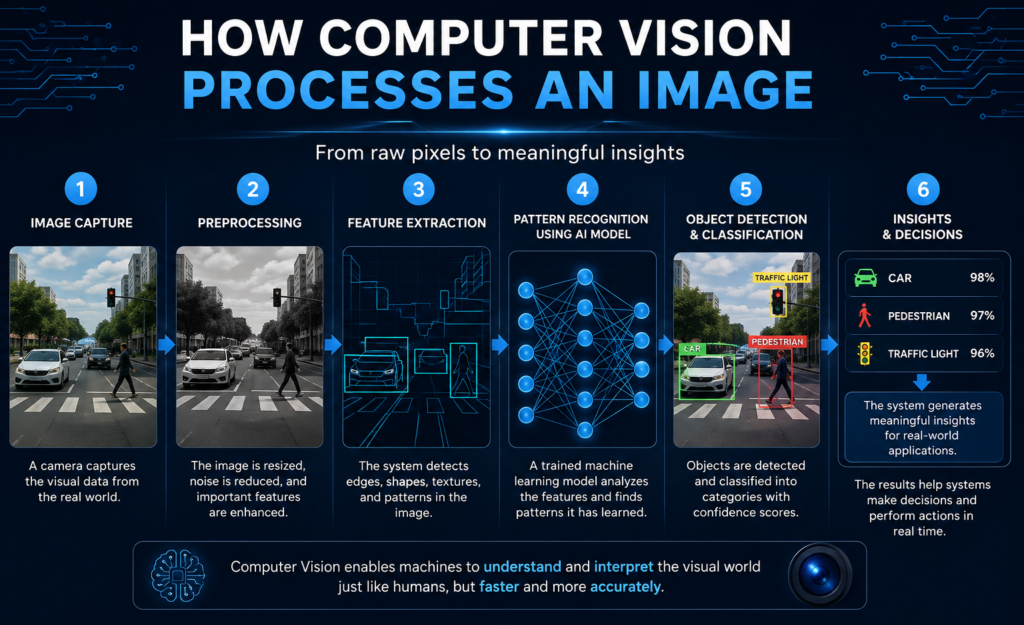
Before a computer vision system can produce useful results, the image passes through several processing stages.
First, unnecessary visual noise is reduced while important features become more noticeable.
Next, AI models examine shapes, textures, colors, edges, and spatial relationships between objects.
Deep learning algorithms compare these features with patterns learned during training.
Finally, the software generates an interpretation that may include identifying an object, detecting a defect, recognizing a face, estimating movement, or predicting what is happening within the scene.
This entire process often takes only fractions of a second, making computer vision suitable for applications where immediate decisions are essential.
Why Visual AI Is Becoming a Business Priority
Businesses no longer see computer vision as experimental technology.
Instead, it has become a practical tool for improving efficiency, reducing operational costs, and making faster decisions based on visual information.
Organizations that previously depended on manual inspections or continuous human monitoring are increasingly adopting computer vision to automate repetitive visual tasks while allowing employees to focus on higher-value work.
From manufacturing plants to hospitals and logistics companies, visual AI is becoming part of everyday business operations rather than a future innovation.
Where Computer Vision Is Creating Real Business Value
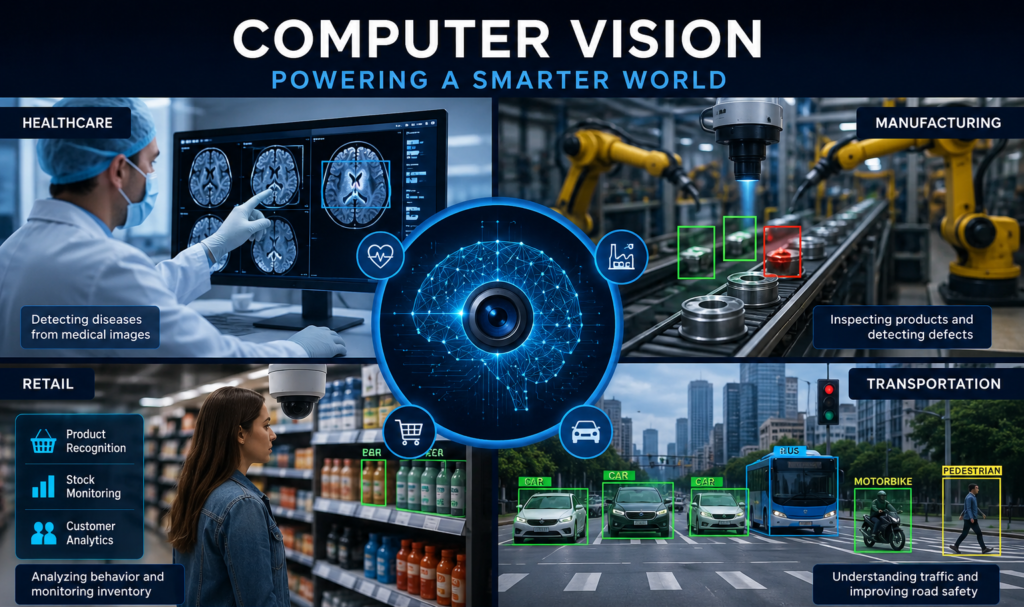
Computer vision is no longer confined to research laboratories or technology companies. Today, it plays an active role in industries where speed, precision, and consistency are essential. Instead of replacing professionals, it supports them by analyzing visual information at a scale that would be difficult for humans to achieve alone.
Healthcare
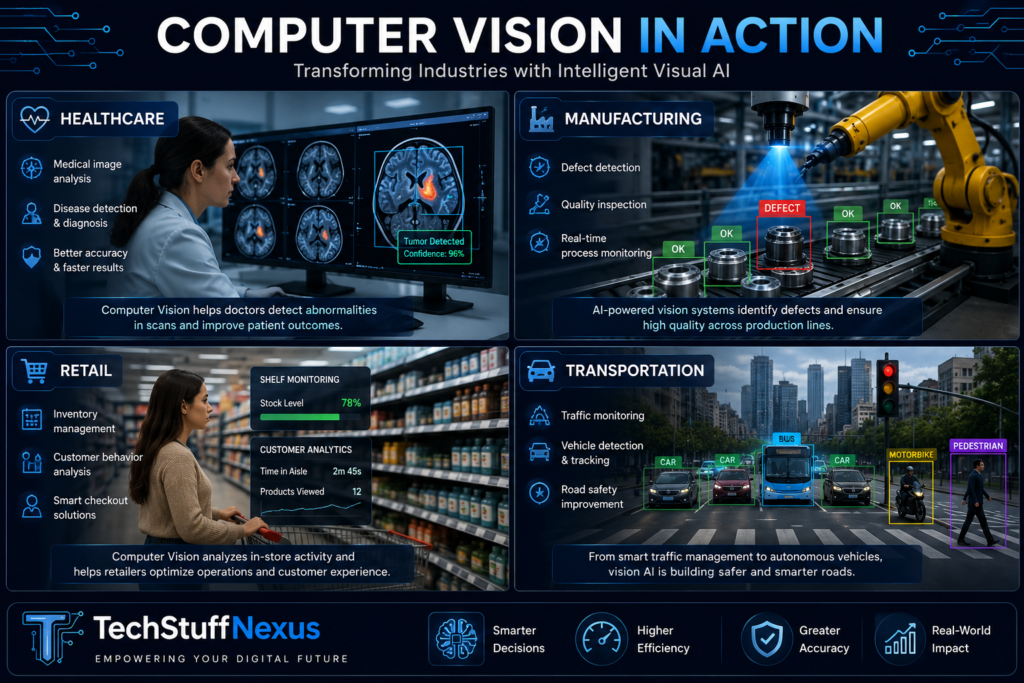
Medical imaging has become one of the strongest applications of computer vision. Hospitals generate thousands of X-rays, CT scans, MRIs, and ultrasound images every day.
AI-powered vision systems help medical professionals identify unusual patterns, highlight areas that deserve closer attention, and organize diagnostic information more efficiently. While doctors continue making the final decisions, Computer Vision provides valuable assistance during the review process.
Manufacturing
Quality control has traditionally relied on manual inspection, especially in industries where even small defects can affect product performance.
Computer vision allows manufacturers to inspect products continuously on production lines, identifying scratches, missing components, incorrect assembly, or surface imperfections within seconds.
This improves production efficiency while reducing unnecessary waste.
Retail
Retail businesses increasingly rely on visual AI to simplify operations.
Computer vision supports tasks such as
- monitoring inventory levels
- analyzing customer shopping behavior
- enabling cashier-free checkout systems
- improving warehouse management
Rather than replacing employees, these systems allow staff to focus on customer service while routine monitoring happens automatically.
Transportation
Modern transportation systems generate enormous amounts of visual data through cameras installed on roads, vehicles, and public infrastructure.
Computer vision helps analyze traffic conditions, recognize road signs, monitor vehicle movement, and improve road safety by identifying unusual situations more quickly than manual observation.
Why Organizations Continue Investing in Visual AI
Businesses are investing in computer vision because visual information has become one of their most valuable assets.
Every day, organizations collect images and videos through smartphones, drones, industrial equipment, surveillance systems, satellites, and connected devices.
Without AI, reviewing all that information manually would require enormous time and resources.
Computer vision helps organizations:
- analyze visual information more efficiently
- improve operational accuracy
- reduce repetitive manual inspections
- support faster business decisions
- improve workplace safety
- automate routine monitoring tasks
Its value comes not from replacing human expertise but from handling repetitive visual analysis with remarkable speed and consistency.
The Challenges That Still Exist
Although computer vision has advanced rapidly, several challenges remain.
Lighting Conditions
Poor lighting, shadows, reflections, or bad weather can reduce recognition accuracy.
Changing Environments
Objects may appear different depending on camera angles, backgrounds, or movement, making reliable recognition more difficult.
Large Data Requirements
Training accurate computer vision models often requires millions of labeled images, which can be expensive and time-consuming to prepare.
Privacy Concerns
Applications involving facial recognition or public surveillance raise important questions about privacy, transparency, and responsible AI use.
Researchers continue developing techniques that improve accuracy while addressing these technical and ethical challenges.
What’s Next for Computer Vision?
Computer vision continues evolving as artificial intelligence becomes more capable.
Future developments are expected to include:
- smarter autonomous vehicles
- more advanced medical imaging systems
- improved industrial robotics
- AI-powered smart cities
- precision agriculture
- faster visual inspection in manufacturing
- more reliable augmented reality experiences
Instead of simply recognizing objects, future computer vision systems are expected to understand complex environments, predict events, and work more naturally alongside humans.
Final Thoughts
Images and videos now represent one of the world’s fastest-growing sources of digital information. Turning that visual data into meaningful insights has become increasingly important for businesses across every major industry.
Computer vision provides the technology that makes this possible. By enabling machines to recognize patterns, detect objects, and interpret scenes, it supports faster decisions, improves efficiency, and helps organizations solve problems that once depended entirely on human observation.
As artificial intelligence continues advancing, computer vision is expected to become an even more important part of healthcare, manufacturing, transportation, retail, and countless other industries where understanding visual information creates real business value.
To explore computer vision in greater detail, readers can visit IBM’s official guide, which explains how this technology is transforming industries through artificial intelligence, image analysis, and automation.
Frequently Asked Questions
What is computer vision?
Computer vision is a branch of artificial intelligence that enables computers to analyze and understand images and videos.
How does computer vision work?
It uses machine learning and deep learning models trained on large image datasets to recognize patterns, classify objects, and interpret visual information.
Where is computer vision used?
It is widely used in healthcare, manufacturing, retail, transportation, agriculture, security, robotics, and smart city technologies.
Is computer vision the same as image processing?
No. Image processing focuses on improving or modifying images, while computer vision aims to understand and interpret what those images contain.
Why is computer vision important?
It helps organizations analyze visual data faster, automate repetitive inspections, improve decision-making, and increase operational efficiency.