
Deep Learning Explained: A Beginner’s Guide to Neural Networks, Applications, and Future Trends
Artificial Intelligence (AI) is changing the way people live, work, and communicate. From voice assistants and self-driving cars to medical diagnosis and personalized recommendations, AI has become an important part of everyday life. One of the most advanced branches of artificial intelligence is deep learning. This technology enables computers to learn from large amounts of data and make intelligent decisions with very little human intervention.
Unlike traditional computer programs that depend on fixed instructions, this technology can recognize patterns, improve through experience, and solve complex problems on its own. Today, it powers many popular AI applications, including speech recognition, image analysis, language translation, recommendation systems, and content generation.
Whether you’re a student, technology enthusiast, or business professional, learning about deep learning can help you understand how modern AI systems operate and why they are becoming more important in today’s digital world.
What Is Deep Learning?
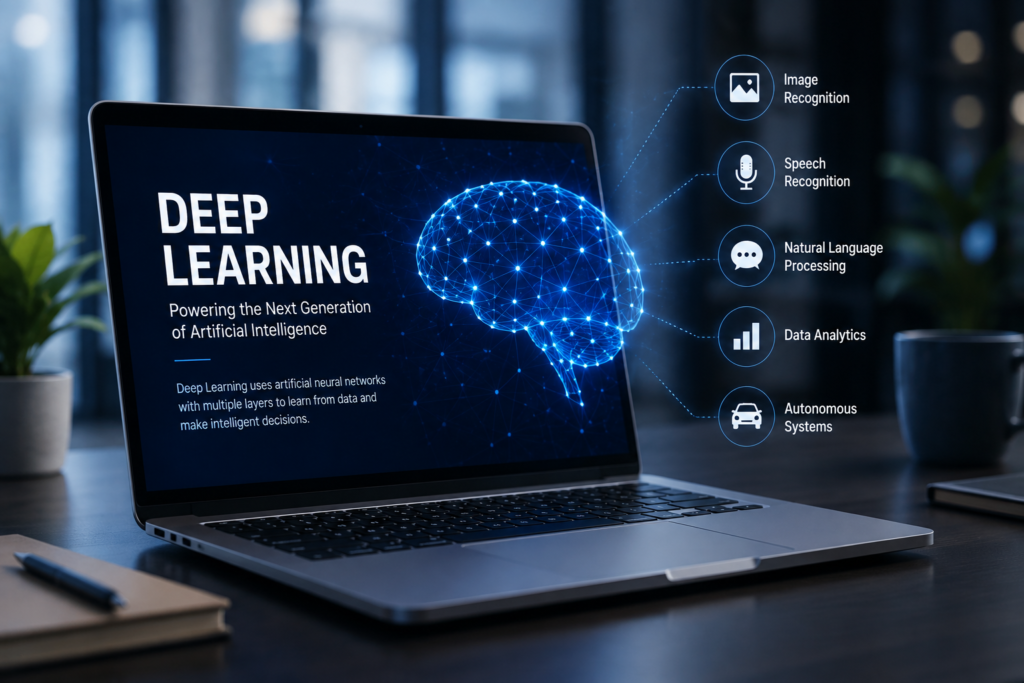
Deep learning is a specialized branch of machine learning that uses artificial neural networks to process information in a way that is inspired by the human brain. These neural networks contain multiple layers that work together to recognize patterns, classify information, and produce accurate predictions.
The word “deep” refers to the many hidden layers inside these networks. Each layer processes information differently, allowing the model to understand increasingly complex relationships within the data.
Unlike traditional machine learning techniques, this technology automatically discovers useful features from large datasets. As a result, developers spend less time manually preparing data, while the model continues improving its performance through training.
How Does Deep Learning Work?
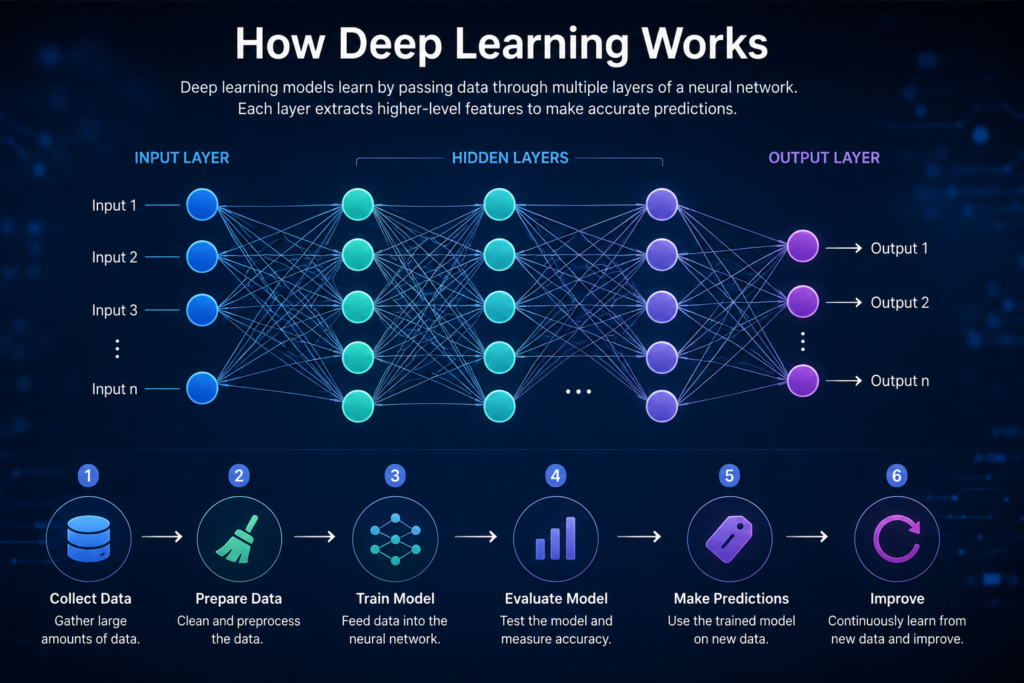
Deep learning models learn by studying thousands or even millions of examples. During training, the model receives input data, compares its predictions with the correct answers, measures the errors, and updates itself to improve future results.
This learning cycle continues repeatedly until the model reaches a high level of accuracy.
A typical workflow includes:
- Collecting large amounts of data
- Cleaning and preparing the dataset
- Training a neural network
- Testing the model’s performance
- Making predictions using new information
- Continuously improving accuracy
The availability of high-quality data plays a major role in improving the overall performance of these intelligent systems.
What Are Neural Networks?
Artificial neural networks form the foundation of this technology. They are designed to imitate how neurons communicate inside the human brain, allowing computers to process information in a structured and intelligent way.
A neural network normally consists of three main layers.
Input Layer
The input layer receives raw information such as text, numbers, images, videos, or audio files before sending it for processing.
Hidden Layers
Hidden layers analyze the information step by step. Each layer learns different features, helping the model recognize more detailed patterns and relationships.
Output Layer
The output layer generates the final prediction or decision. For example, it may recognize an object in an image, translate a sentence into another language, recommend a product, or identify a person’s voice.
This layered design enables modern AI systems to solve tasks that would be extremely difficult using traditional programming methods.
Key Benefits of Deep Learning
This technology has become one of the most powerful developments in artificial intelligence because it offers several important advantages.
High Accuracy
These intelligent models can achieve excellent accuracy when trained with large, high-quality datasets.
Automatic Feature Learning
Instead of requiring developers to manually define important features, the system automatically discovers meaningful patterns from data.
Handles Large Data Efficiently
This approach performs exceptionally well when processing both structured and unstructured information, making it suitable for large-scale AI applications.
Continuous Improvement
As more data becomes available, these models continue to learn and deliver more accurate results over time.
Supports Advanced AI Applications
Many modern AI systems, including image recognition, recommendation engines, autonomous vehicles, and language translation tools, depend on advanced neural network technology.
Real-World Applications of Deep Learning
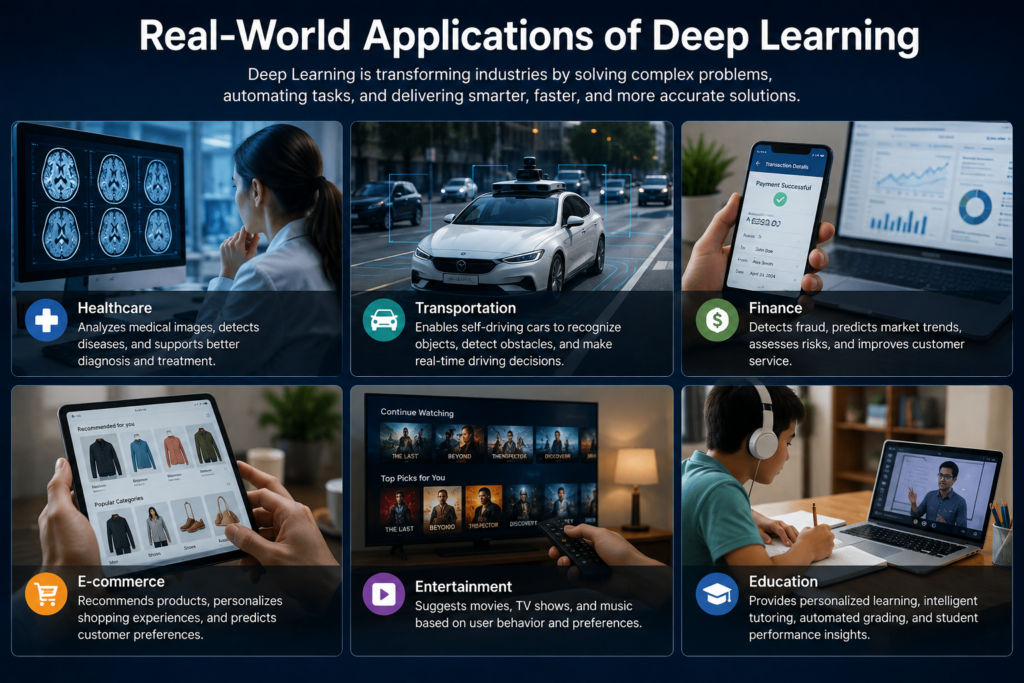
Deep learning has become one of the most valuable technologies in artificial intelligence. Organizations around the world use it to improve efficiency, automate repetitive tasks, and make smarter decisions. As AI continues to evolve, its applications are expanding across almost every major industry.
Healthcare
Hospitals and medical researchers use this technology to analyze medical images, detect diseases at an early stage, and support doctors in making more accurate diagnoses. It also helps accelerate drug discovery, monitor patients, and create personalized treatment plans that improve healthcare outcomes.
Finance
Banks and financial institutions rely on advanced AI models to detect fraudulent transactions, evaluate financial risks, monitor unusual account activity, and improve customer service through intelligent virtual assistants. These capabilities help organizations provide faster, safer, and more reliable financial services.
Transportation
Self-driving vehicles use advanced neural network technology to recognize road signs, identify pedestrians, detect obstacles, and make real-time driving decisions. These intelligent systems continue to improve road safety while supporting the future of autonomous transportation.
E-commerce
Online shopping platforms use intelligent recommendation systems to suggest products based on customer interests, browsing history, and previous purchases. This creates a more personalized shopping experience while increasing customer satisfaction.
Entertainment
Streaming platforms use this technology to recommend movies, TV shows, and music based on viewing and listening habits. These recommendations help users discover content that matches their personal preferences.
Education
Educational platforms use intelligent learning systems to personalize lessons, automate assessments, and provide virtual tutoring that helps students learn more effectively.
Challenges of Deep Learning
Although deep learning has achieved remarkable success, several challenges still need to be addressed before it reaches its full potential.
Requires Large Amounts of Data
This technology performs best when trained using large, high-quality datasets. Limited or poor-quality data can reduce accuracy and affect overall performance.
High Computing Power
Training advanced neural networks requires powerful computers, high-performance GPUs, and significant processing time. As a result, developing AI models can be expensive for smaller businesses and research teams.
Limited Explainability
Many AI models work as “black boxes,” meaning it is difficult to understand exactly how they reach certain decisions. Researchers continue working on methods that make these systems more transparent and trustworthy.
Ethical Concerns
Using artificial intelligence responsibly is another important challenge. Developers must ensure AI systems are fair, transparent, protect user privacy, and minimize bias when making decisions.
The Future of Deep Learning
This technology continues to evolve at an impressive pace. Researchers are developing models that are faster, more accurate, more energy-efficient, and capable of solving increasingly complex problems.
In the coming years, deep learning is expected to play an even greater role in healthcare, education, cybersecurity, robotics, autonomous vehicles, scientific research, agriculture, and smart manufacturing. Businesses will continue adopting AI-powered solutions to improve productivity, reduce operational costs, and deliver better customer experiences.
Many experts believe this technology will remain one of the driving forces behind future AI innovation, helping organizations solve real-world challenges while creating smarter digital solutions.
Why Businesses Are Investing in This Technology
Businesses across the world are investing heavily in this technology because it helps improve efficiency, reduce operational costs, and support better decision-making. Companies can analyze large amounts of data much faster than traditional software, allowing them to identify trends, predict customer behavior, and automate routine tasks. As competition continues to grow, organizations are using intelligent systems to deliver personalized services, improve customer satisfaction, and increase productivity. From small startups to global enterprises, many businesses see AI-powered solutions as an important part of their future growth strategies.
Deep Learning vs. Machine Learning
Although both technologies are closely related, they are not exactly the same. Machine learning usually requires developers to select important features before training a model, while deep learning automatically learns those features from large datasets. Traditional machine learning works well for smaller datasets and simpler tasks, whereas this technology performs better when handling complex information such as images, videos, speech, and natural language. Choosing the right approach depends on the type of project, the amount of available data, and the computing resources required.
Frequently Asked Questions (FAQ)
What is deep learning in simple words?
Deep learning is an advanced AI technology that allows computers to learn from large amounts of data using artificial neural networks. It helps machines recognize patterns, make predictions, and improve their performance over time.
Why is deep learning important?
It powers many modern AI applications, including voice assistants, image recognition, language translation, recommendation systems, and autonomous vehicles. Its ability to solve complex problems makes it valuable across many industries.
What is the difference between deep learning and artificial intelligence?
No. Artificial intelligence is the broader field, while deep learning is a specialized branch of machine learning that focuses on training neural networks using large datasets.
Conclusion
Deep learning has become one of the most important technologies driving the rapid growth of artificial intelligence. By using powerful neural networks and learning from massive amounts of data, it enables computers to recognize patterns, make intelligent decisions, and automate complex tasks with impressive accuracy.
From healthcare and finance to education and transportation, this technology is already transforming industries around the world. While challenges such as data requirements, computing costs, and ethical concerns still exist, ongoing research continues to improve its capabilities and expand its practical applications.
As artificial intelligence continues to advance, deep learning will remain at the center of innovation, helping create smarter systems that improve everyday life and solve complex business and scientific problems more efficiently.
If you’re new to AI, you can also read our Machine Learning Explained guide to understand the fundamentals before exploring more advanced AI concepts. You may also enjoy our Generative AI Explained article to learn how modern AI systems create text, images, code, and other digital content.
For more information about artificial intelligence and the latest AI innovations, visit the official OpenAI website.