
Confidential Computing Explained: How It Works, Benefits, Uses & Security
As businesses move more applications and sensitive information to cloud environments, protecting data has become increasingly important. Traditional security methods can protect information while it is stored or transferred, but organizations may also need to protect sensitive data while it is actively being processed.
This is where Confidential Computing comes into the picture.
Confidential computing is a security approach designed to protect sensitive information while it is being processed by using specialized hardware-based protection. Instead of relying only on traditional software security controls, confidential environments can help restrict access to data while applications are running.
The technology can be useful for organizations working with financial information, healthcare records, intellectual property, artificial intelligence workloads, and other sensitive data.
What Is Confidential Computing?
Confidential computing is a security technology designed to protect data while it is being processed.
Data generally exists in three important states:
- Data at rest — information stored on devices or servers
- Data in transit — information moving between systems
- Data in use — information actively being processed by applications
Traditional security technologies have long focused on protecting stored and transmitted information through methods such as encryption.
Confidential computing focuses particularly on data in use.
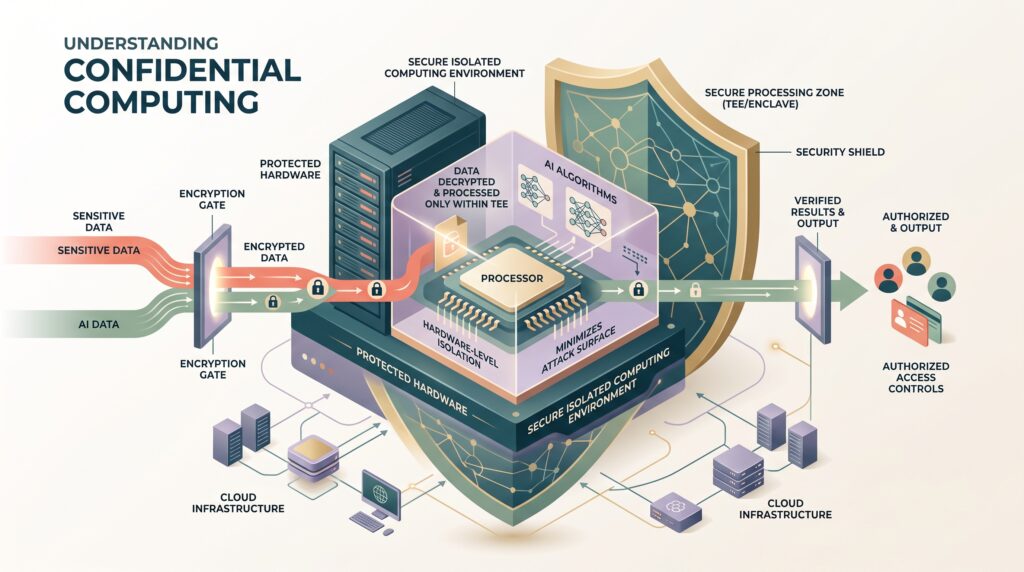
The basic idea is to create a protected area within a computing environment where sensitive information can be processed while reducing the ability of unauthorized software or users to access it.
This can be particularly useful in cloud environments, where organizations may want to process sensitive information without exposing it unnecessarily to the underlying infrastructure.
How Does Confidential Computing Work?
Confidential computing typically relies on hardware-based security mechanisms to isolate sensitive workloads from other parts of the computing environment.
A simplified process looks like this:
Application → Protected Environment → Data Processing → Protected Result
The exact implementation depends on the hardware, operating system, cloud platform, and security architecture being used.
1. Sensitive Data Enters the Environment
An application receives information that needs to be processed.
This could include financial records, customer information, proprietary business data, or information used by an AI application.
2. The Workload Enters a Protected Environment
The application or selected workload runs inside a protected computing area.
This environment is designed to restrict unauthorized access to the information being processed.
3. Data Is Processed
The application performs its required operations while the sensitive information remains within the protected environment.
4. Results Are Returned
After processing, the application can return the required result to the authorized user or system.
The goal is to reduce unnecessary exposure of sensitive information during computation.
What Is a Trusted Execution Environment?
A major concept associated with confidential computing is the Trusted Execution Environment (TEE).
A TEE is a protected area within a computing system that is designed to isolate sensitive code and data from the normal operating environment.
Think of it as a secure workspace inside a computer.
Applications running outside that workspace may have limited or no access to the sensitive information being processed inside it.
This type of isolation can be useful when organizations need stronger protection for specific workloads.
However, a TEE is not simply a software folder with a password. Its security depends on hardware mechanisms, system design, implementation, configuration, and the technologies used by the particular platform.
Confidential Computing vs Traditional Encryption
Encryption remains one of the most important technologies in cybersecurity.
For example, organizations can encrypt information while it is stored and while it travels between systems.
However, applications generally need access to usable data before they can process it.
This creates an important security consideration.
Confidential computing aims to provide protection during this processing stage.
A simplified comparison is
| Data State | Common Protection |
| Data at rest | Encryption |
| Data in transit | Encryption and secure communication |
| Data in use | Confidential computing techniques |
This does not mean confidential computing replaces encryption.
Instead, the technologies can work together as part of a broader security architecture.
7 Benefits of Confidential Computing
1. Better Protection for Sensitive Data
One of the main potential benefits is additional protection for information while it is being processed.
This can be valuable for organizations handling sensitive customer, financial, medical, or business information.
2. Improved Cloud Security
Organizations increasingly use cloud infrastructure for applications and data processing.
Confidential computing can provide an additional security layer for workloads that require stronger isolation.
This can be especially relevant when sensitive workloads are processed on infrastructure operated by a third-party provider.
3. Reduced Data Exposure
Organizations may want to minimize the number of systems and processes that can access sensitive information.
A protected processing environment can help reduce unnecessary exposure during certain operations.
4. Support for Sensitive Collaboration
Different organizations sometimes need to work with shared datasets without unnecessarily exposing all of the underlying information.
Confidential computing can potentially support these types of privacy-sensitive workloads when combined with appropriate data governance and access controls.
5. Protection for Intellectual Property
Businesses may process proprietary algorithms, business models, research data, or other valuable information.
Protecting both the data and the software processing it can be important for organizations concerned about intellectual property.
6. Support for AI Workloads
Artificial intelligence applications can process highly sensitive information.
For example, organizations may want to use AI models with private business or customer data while limiting unnecessary exposure of that information.
Confidential environments can provide an additional security mechanism for these workloads.
7. Stronger Security Architecture
Confidential computing can become one component of a broader defense-in-depth strategy.
Organizations can combine it with encryption, identity management, access controls, monitoring, and other security technologies.
Confidential Computing in Cloud Computing
Cloud computing is one of the areas where this technology can be particularly useful.
Organizations often rely on external infrastructure to run applications, store information, and process data. Confidential computing can provide an additional security layer for workloads running in cloud computing environments.
However, sensitive workloads can create additional security requirements.
Confidential computing can help organizations create protected processing environments for selected workloads. IBM describes confidential computing as an approach that helps protect data while it is being processed in trusted environments.
For example, a company could run an application that processes sensitive financial information inside a protected environment instead of exposing the information unnecessarily to the broader computing environment.
This does not eliminate the need for normal cloud security practices.
Organizations still need to manage:
Confidential Computing and Artificial Intelligence
- User identities
- Access permissions
- Application security
- Network security
- Data governance
- Monitoring
- Backups
- Security policies
AI systems can require access to large amounts of information.
In some situations, the information used by an AI application may be highly sensitive.
For example, an organization might want to analyze private customer information or proprietary business data without unnecessarily exposing the underlying dataset.
Confidential computing can provide a protected environment where certain AI workloads can process sensitive information.
This can be useful for applications involving:
- Private AI models
- Sensitive business data
- Financial information
- Healthcare information
- Proprietary research
- Customer analytics
Confidential environments can also support sensitive machine learning workloads where private datasets need additional protection. The technology does not automatically make an AI system secure.
AI applications still require appropriate access controls, model security, data governance, monitoring, and testing.
However, confidential environments can become another layer within the overall security architecture.
Confidential Computing and Cybersecurity
Confidential computing is closely related to the broader field of cybersecurity because its primary purpose is protecting sensitive workloads and information.
Organizations can combine confidential computing with other security measures such as the following:
- Encryption
- Multi-factor authentication
- Identity management
- Access controls
- Security monitoring
- Vulnerability management
- Secure software development
- Network protection
This layered approach is important because no single technology can eliminate every security risk.
For example, protecting data inside a trusted execution environment does not automatically protect an account with a weak password or an application containing a security vulnerability.
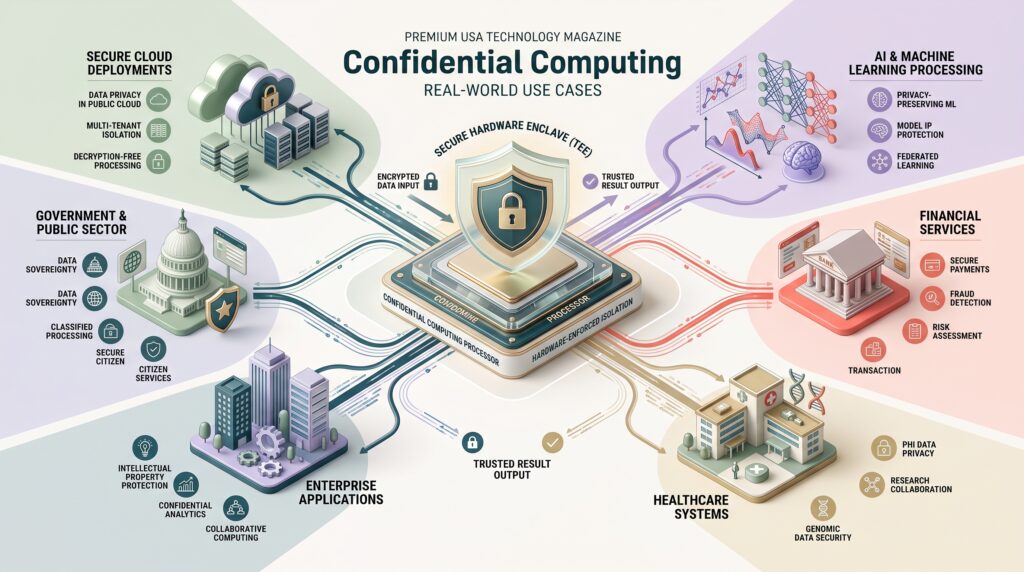
Real-World Uses of Confidential Computing
Confidential computing can be considered for many types of sensitive workloads.
Financial Services
Banks and financial companies handle highly sensitive customer and transaction information.
Protected processing environments may help organizations perform certain operations while reducing unnecessary exposure of sensitive data.
Potential applications include:
- Financial analytics
- Fraud detection
- Risk analysis
- Customer data processing
- Secure financial collaboration
Healthcare
Healthcare organizations manage sensitive medical and personal information.
Confidential computing can potentially help protect certain workloads involving medical datasets and healthcare applications.
Because healthcare information is highly sensitive, privacy, security, compliance, and access controls remain essential.
Government
Government organizations may handle sensitive citizen information, research, and operational data.
Protected computing environments can potentially help support workloads where information security is particularly important.
Enterprise Applications
Large companies may process confidential business information such as customer records, financial data, intellectual property, and internal analytics.
Confidential environments can be considered for applications where stronger workload isolation is required.
Artificial Intelligence
Organizations developing AI systems may want to protect training data, models, or inference workloads.
Confidential computing can potentially help create protected environments for selected AI operations.
Confidential Computing and Data Privacy
Data privacy is becoming increasingly important as organizations collect and process more information.
Simply encrypting stored information may not address every privacy concern because applications still need to process usable data.
Confidential computing attempts to address part of this challenge by protecting information while it is being processed.
However, privacy is broader than technical isolation.
Organizations still need to consider:
- What data they collect
- Why they collect it
- Who can access it
- How long it is retained
- Where it is processed
- How it is shared
- How users can control their information
Confidential computing should therefore be viewed as one component of a larger privacy and security strategy.
Challenges of Confidential Computing
Despite its potential benefits, confidential computing also has limitations.
Hardware Requirements
The technology depends on specific hardware and security capabilities.
Organizations may therefore need compatible infrastructure before they can deploy certain confidential workloads.
Implementation Complexity
Setting up protected environments can require specialized knowledge.
Security teams need to understand the hardware, software, applications, identity systems, and deployment architecture involved.
Performance Considerations
Security mechanisms can sometimes introduce additional processing requirements.
The impact varies depending on the workload and implementation.
Organizations should test performance before deploying critical applications at scale.
Limited Compatibility
Not every application is automatically designed to run inside a confidential environment.
Some applications may require modification or specialized deployment methods.
Operational Complexity
Adding another security layer can increase management requirements.
Organizations need appropriate monitoring, configuration management, testing, and maintenance processes.
Confidential Computing vs Traditional Cloud Security
Traditional cloud security uses multiple technologies to protect infrastructure, applications, identities, networks, and data.
Confidential computing focuses more specifically on protecting sensitive workloads while they are being processed.
The two approaches are therefore complementary rather than competing technologies.
For example, an organization could use the following:
Encryption + Identity Management + Network Security + Confidential Computing
Together, these controls can provide multiple layers of protection.
The exact architecture depends on the organization’s risk profile and the sensitivity of its workloads.
The Future of Confidential Computing
The importance of protecting sensitive workloads is likely to grow as organizations continue adopting cloud services, AI applications, distributed systems, and data-intensive technologies.
Confidential computing could become increasingly relevant for organizations that need to process sensitive information while maintaining stronger control over workload isolation.
The combination of confidential environments with AI, cloud infrastructure, and privacy-focused technologies may create new opportunities for secure data processing.
At the same time, organizations will need to address compatibility, cost, performance, hardware requirements, and operational complexity.
The technology should therefore be evaluated based on actual security requirements rather than treated as a universal solution.
Frequently Asked Questions
What is Confidential Computing?
Confidential computing is a security approach designed to protect sensitive data and workloads while they are being processed, often through hardware-based isolation.
Is confidential computing the same as encryption?
No. Encryption can protect data while it is stored or transferred, while confidential computing focuses particularly on protecting data and workloads during processing.
What is a Trusted Execution Environment?
A Trusted Execution Environment is a protected area within a computing system designed to isolate sensitive code and data from the normal computing environment.
Can confidential computing protect AI workloads?
Yes, confidential environments can potentially be used to protect selected AI workloads, sensitive datasets, and model-related operations.
Is confidential computing only for cloud services?
No. Although cloud environments are an important use case, the underlying technology can also be relevant to other computing environments where sensitive processing needs additional protection.
Does confidential computing replace cybersecurity?
No. It is one security technology within a broader cybersecurity strategy. Organizations still need identity management, encryption, access controls, monitoring, secure applications, and other protections.
Conclusion
Confidential computing provides an additional approach to protecting sensitive information during processing.
By using hardware-based isolation and trusted execution environments, organizations can create protected areas for selected applications and workloads.
The technology can be useful in cloud computing, financial services, healthcare, government, enterprise applications, and artificial intelligence.
However, confidential computing is not a replacement for traditional security practices. Encryption, identity management, access controls, monitoring, secure software, and strong security policies remain important.
As businesses increasingly process sensitive information through cloud and AI systems, technologies that help protect data during computation may become an increasingly important part of modern security architectures.
The most effective approach is to evaluate the technology according to the sensitivity of the workload, security requirements, performance needs, and operational capabilities of the organization.