Digital Twins Explained: 7 Powerful Applications, Benefits & Future
Digital technology is changing how companies design, monitor, and improve real-world systems. One technology gaining attention across industries is digital twins.
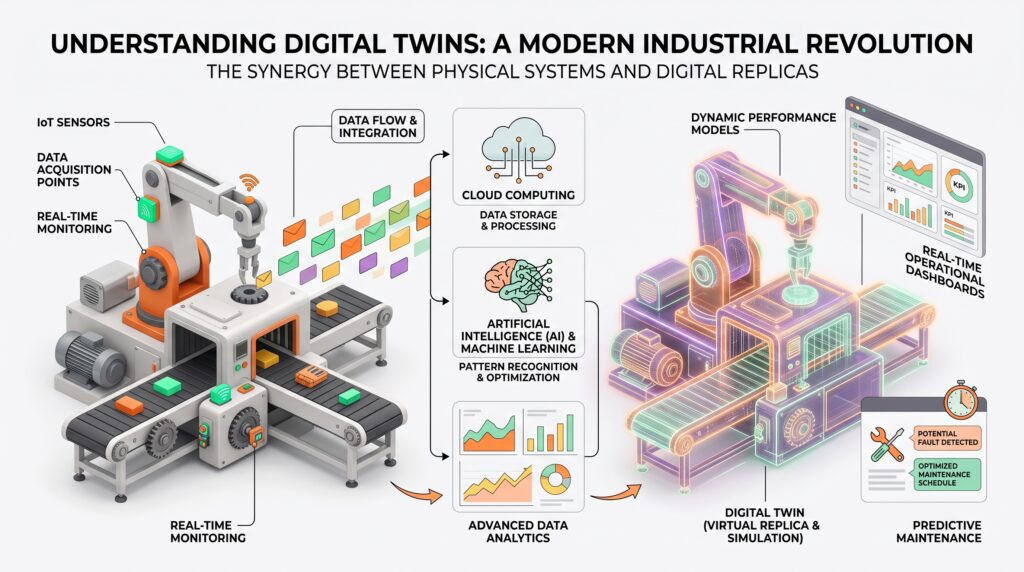
A digital twin is a virtual representation of a real-world object, machine, process, or system. It can use information from sensors and other data sources to represent what is happening in the physical world.
For example, a factory can create a digital representation of a machine and use incoming data to monitor its condition. Engineers may then analyze that information to identify unusual behavior, test possible changes, or plan maintenance.
Digital twins are being explored in manufacturing, transportation, energy, healthcare, smart cities, and other technology-driven industries.
What Is a Digital Twin?
A digital twin is a digital representation of a physical object, process, or system that can be updated using information from the real-world counterpart.
The physical object could be a machine, vehicle, building, wind turbine, production line, or even a larger infrastructure system.
The digital representation can contain information about the condition, behavior, performance, or operation of the physical system.
The important idea is the connection between the physical and digital environments.
Instead of simply creating a static computer model, a digital twin can be connected to continuously changing data.
This allows organizations to observe what is happening in the real world and analyze that information in a digital environment.
However, not every 3D model or computer simulation is automatically a digital twin. A useful digital twin generally involves some form of connection between the digital representation and the physical system it represents.
How Do Digital Twins Work?
The basic operation can be understood through several connected components.
1. Physical Object
Everything begins with a real-world object, machine, process, or environment.
For example, consider an industrial machine operating inside a manufacturing facility.
The machine has physical characteristics and produces information while it operates.
2. Sensors and Data Collection
Sensors can collect information about the physical system.
Depending on the application, sensors might monitor the following:
- Temperature
- Pressure
- Vibration
- Speed
- Energy consumption
- Location
- Humidity
- Performance measurements
The type and amount of data depend on the system being monitored.
3. Data Transmission
The collected information needs to reach the digital environment.
This may happen through connected networks, IoT systems, local infrastructure, or cloud-based platforms.
The data can then be processed and organized for analysis.
4. Digital Representation
The collected information is connected to a digital representation of the physical system.
This representation can show important characteristics of the real object and, depending on the technology, may update as new information becomes available.
5. Analysis and Decision-Making
Once information is available in the digital environment, engineers and organizations can analyze it.
They may use dashboards, simulations, analytics, artificial intelligence, or other software tools to understand the system.
The resulting information can help people make decisions about maintenance, performance, design, or operations.
A Simple Digital Twin Example
Imagine a company that operates hundreds of industrial machines.
Traditionally, technicians might inspect machines according to a fixed maintenance schedule.
With a connected digital twin system, sensors could continuously collect information such as vibration and temperature.
The digital environment can then display the machine’s condition.
If the data begins to show unusual behavior, engineers may investigate the machine before a serious problem develops.
The goal is not necessarily to predict every failure perfectly. Instead, the technology can provide additional information that may help organizations make better maintenance and operational decisions.
Types of Digital Twins
Digital twins can be used at different levels of complexity.
Component Twins
A component twin represents an individual part of a larger system.
For example, an organization could create a digital representation of a motor, pump, battery, or other important component.
Monitoring individual components can help engineers understand their performance and condition.
Asset Twins
An asset twin represents a complete physical asset that may contain multiple components.
A manufacturing machine or aircraft engine could be treated as an asset.
The digital representation can combine information from different components to provide a broader view of the asset.
System Twins
A system twin represents multiple connected assets or components working together.
For example, a production line may contain several machines that depend on each other.
A system-level representation can help engineers understand how changes in one part may affect other parts.
Process Twins
A process twin focuses on a workflow or operational process.
For example, a manufacturer could model a production process to understand how changes in timing, resources, or equipment may influence overall performance.
These categories can overlap depending on how a particular organization designs its digital twin environment.
Digital Twins in Manufacturing
Manufacturing is one of the most important areas for digital twin technology. IBM also describes digital twins as a way to use real-time data and digital models to understand physical systems and support business decisions.
Factories contain machines, production lines, sensors, and automated systems that generate large amounts of operational data.
A digital representation can help manufacturers monitor equipment and understand production behavior.
Potential uses include:
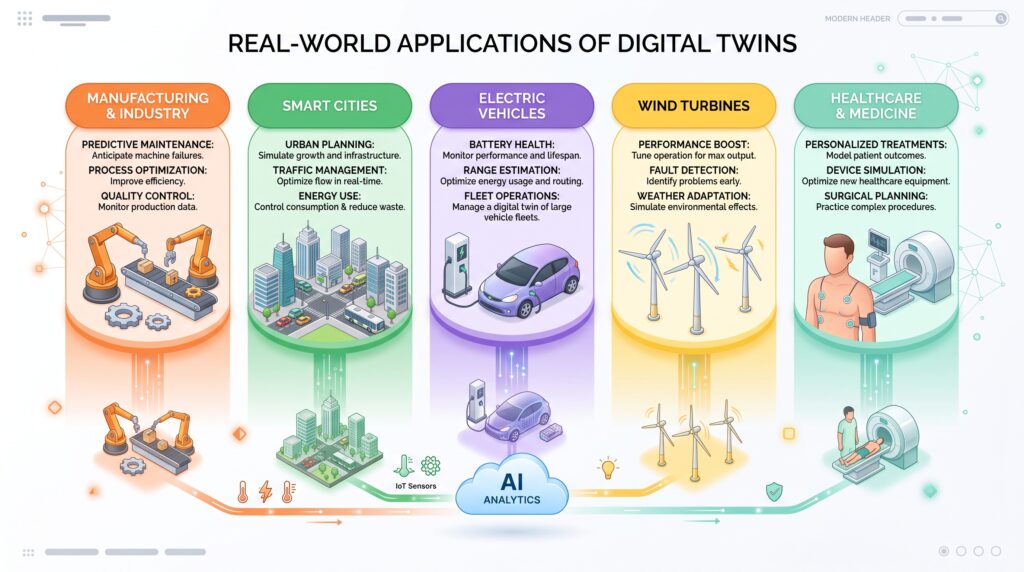
- Equipment monitoring
- Production optimization
- Maintenance planning
- Quality analysis
- Factory design
- Process simulation
- Energy management
Before changing a production process in the real factory, engineers may also be able to evaluate possible changes within a digital environment.
This can reduce the need to experiment directly with physical equipment.
Digital Twins and the Internet of Things
The Internet of Things (IoT) is closely connected with digital twins.
IoT devices and sensors can collect information from physical environments, while digital twin platforms can use that information to represent and analyze the corresponding systems. Edge computing can also process some data closer to connected devices before it is sent to a central platform.
For example, sensors installed on a machine may continuously send information about temperature and vibration.
That data can be used to update the machine’s digital representation.
The relationship can be simplified as
Physical System → IoT Sensors → Data → Digital Twin → Analysis
This connection allows organizations to combine physical monitoring with digital analysis.
Digital Twins and Artificial Intelligence
Artificial intelligence can add another layer of analysis to digital twin systems.
A digital twin can provide information about a physical system, while AI and machine learning models can analyze that information to identify patterns or unusual behavior.
For example, historical sensor data could potentially be analyzed to identify conditions associated with equipment problems.
AI may also be used for optimization, forecasting, anomaly detection, and decision support. Machine learning can also help analyze historical sensor data and identify patterns that may indicate changes in a physical system.
This combination can be particularly useful when a system generates large amounts of data that would be difficult for humans to analyze manually.
Digital Twins in Smart Cities
Digital twin technology can also be applied to cities and large infrastructure systems.
A smart-city digital environment could represent roads, buildings, transportation systems, energy usage, or other infrastructure.
Data from sensors and connected devices can provide information about real-world conditions.
City planners may then use digital models to explore possible changes.
For example, a digital representation could help analyze traffic patterns or examine how infrastructure might respond to different scenarios.
The complexity of these systems means that implementation can require significant amounts of data, computing resources, and specialized expertise.
Digital Twins in Transportation
Transportation companies can use digital representations to monitor vehicles and infrastructure.
Potential applications include:
- Vehicle performance monitoring
- Maintenance planning
- Fleet management
- Route analysis
- Infrastructure monitoring
- Design and testing
For example, a transportation company could use operational data from vehicles to better understand how different conditions affect performance.
Engineers can then analyze the information without relying entirely on physical inspections.
Digital Twins in Energy
Energy infrastructure can also benefit from digital modeling.
Wind turbines, power equipment, pipelines, and other systems can generate valuable operational information.
A digital representation can help organizations monitor performance and identify unusual changes.
For renewable-energy equipment such as wind turbines, data about factors such as wind conditions, temperature, vibration, and equipment performance can be analyzed together.
This may help operators make better decisions about maintenance and operational efficiency.
Digital Twins in Healthcare
Healthcare is another area where digital twin concepts are being explored.
Potential applications include medical equipment, hospital operations, research, and personalized modeling.
However, healthcare applications require particularly careful consideration because medical data can be sensitive and systems may involve significant safety and privacy requirements.
Digital models should therefore be developed and used with appropriate validation, security, privacy, and regulatory considerations.
Benefits of Digital Twins
Digital twins can provide several potential advantages when implemented correctly.
Better Monitoring
Connected data can provide organizations with more visibility into physical systems.
Instead of relying only on occasional inspections, teams may have access to continuously updated information.
Predictive Maintenance
Analyzing equipment data can help organizations identify patterns that may indicate developing problems.
This may allow maintenance teams to investigate issues earlier and potentially reduce unexpected downtime.
Improved Testing
Organizations can use digital environments to evaluate possible changes before implementing them in the physical world.
This can be useful for complex systems where physical testing is expensive or difficult.
Operational Efficiency
Digital analysis can help organizations identify inefficient processes, unnecessary resource consumption, or performance problems.
The results can support efforts to improve operations.
Reduced Physical Experimentation
In some situations, digital simulations can reduce the need for repeated physical experiments.
However, digital testing does not completely replace real-world validation, especially when safety and physical behavior are important.
Challenges of Digital Twins
Despite their potential, digital twins also introduce challenges.
Data Quality
A digital representation is only as useful as the information supporting it.
Incorrect, incomplete, outdated, or poorly calibrated sensor data can reduce the accuracy of the digital model.
High Implementation Costs
Building a sophisticated digital twin can require sensors, networking equipment, software, storage, computing resources, and specialized employees.
For smaller organizations, the initial investment may be significant.
Security Risks
Connected systems can create additional cybersecurity considerations.
If sensors, networks, platforms, or user accounts are poorly protected, attackers may attempt to access sensitive information or connected infrastructure.
Strong authentication, access controls, monitoring, encryption, and regular security updates can therefore be important. Organizations can also review guidance from NIST on security and trust considerations for digital twin technology.
Integration Complexity
Organizations may already use many different systems and software platforms.
Connecting these technologies together can be difficult, especially when data formats and communication methods differ.
Privacy Concerns
Some digital twin applications can involve sensitive information about people, facilities, vehicles, or operations.
Organizations need to consider how information is collected, stored, processed, and shared.
Digital Twins vs Traditional Simulations
Digital twins and traditional simulations are related but not identical.
A traditional simulation may use predefined information to model how a system could behave under specific conditions.
A digital twin can be connected to information from an actual physical system and may be updated as real-world conditions change.
This connection can make digital twins useful for ongoing monitoring rather than only one-time analysis.
However, traditional simulations remain valuable and can still be used alongside digital twins.
In practice, organizations may combine simulations, sensor data, analytics, and digital models rather than relying on one technology alone.
The Future of Digital Twins
Digital twins are likely to become more sophisticated as connected devices, sensors, cloud infrastructure, AI, and data analytics continue to develop.
Future systems may become better at representing complex physical environments and analyzing large amounts of real-time information.
The combination of digital twins with AI could also enable more advanced forecasting and optimization.
At the same time, organizations will need to address cybersecurity, privacy, data quality, interoperability, and implementation costs.
The technology is therefore unlikely to be useful simply because a company creates a digital model. Its value will depend on whether the model receives reliable information and helps people make meaningful decisions.
Frequently Asked Questions
Are digital twins the same as 3D models?
No. A 3D model can simply represent the appearance or structure of an object. A digital twin generally involves a connection with a physical system and may use real-world data to update or analyze its digital representation.
Do digital twins require IoT?
Not always. IoT sensors are commonly used to provide real-world data, but the exact architecture can vary depending on the application.
Can digital twins use AI?
Yes. AI and machine learning can be used to analyze information associated with digital twin systems for tasks such as anomaly detection, forecasting, and optimization.
Are digital twins only used by large companies?
No. Although large organizations may have more resources for complex implementations, the underlying concept can be applied to smaller systems and specific assets as well.
Are digital twins expensive?
The cost varies significantly. A simple digital representation may require relatively limited resources, while a large industrial or city-scale system can require substantial investment in sensors, software, infrastructure, and expertise.
Conclusion
Digital twins provide a way to connect physical systems with digital representations and real-world data.
From manufacturing machines and vehicles to energy infrastructure and smart cities, the technology can help organizations monitor systems, analyze performance, test possible changes, and support maintenance decisions.
IoT sensors can provide important data, while cloud infrastructure can help process and store information. AI and machine learning can add additional analytical capabilities.
However, digital twins also come with challenges involving cost, data quality, security, privacy, and system integration.
As connected technology continues to expand, digital twins could become an increasingly useful tool for organizations that need better visibility into complex physical systems.
The most important factor will not simply be creating a digital model but using reliable data and meaningful analysis to turn that model into something useful.